
Jazz and AI look a lot alike
Jazz and artificial intelligence seem to live in opposite worlds. Jazz belongs to the body: the breath of the saxophone, the pressure of fingers on the piano, the pulse of a drum kit, the mistake turned into discovery. Artificial intelligence, by contrast, is usually imagined as calculation: servers, models, data, statistical prediction. One seems human to excess; the other technical to the point of coldness.
But that opposition is too simple.
Jazz and AI resemble each other at a deeper point: both produce form in real time from a previous memory. Neither creates from nothing. Jazz improvises over scales, standards, styles, quotations, habits of listening and entire traditions. AI generates from learned patterns, contexts, instructions, examples and probabilities. In both cases, creation does not mean pulling something pure out of a void. It means responding to a situation with inherited materials.
The resemblance is not that a machine “plays” like a musician.
That analogy is poor, and unfair to jazz.
The resemblance appears elsewhere: in the way both turn memory into possibility.
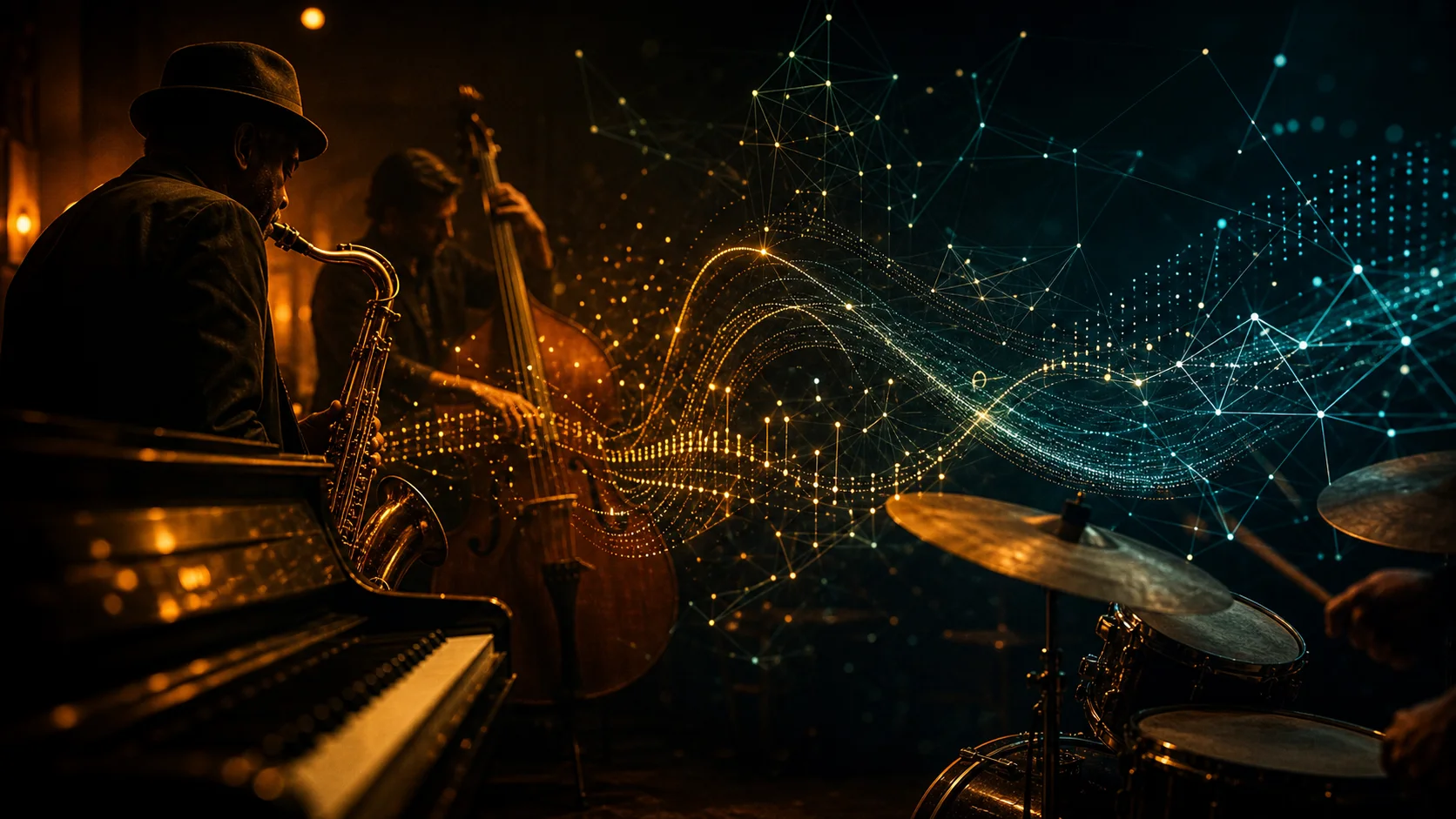
Between memory and invention: a band playing inside a web of signals.
Composition
Jazz is not pure spontaneity.
It has forms, progressions, standards, themes, arrangements, keys, inherited gestures and shared vocabularies. A solo is possible because there is a field in which it can move. Without that field, improvisation becomes noise or private gesture.
The same happens with generative AI. A prompt is not a magical wish. It is closer to an open score. It sets tone, tempo, limits, genre, references, constraints and the kind of answer expected. It does not determine every note, but it creates a space in which variations become more or less probable.
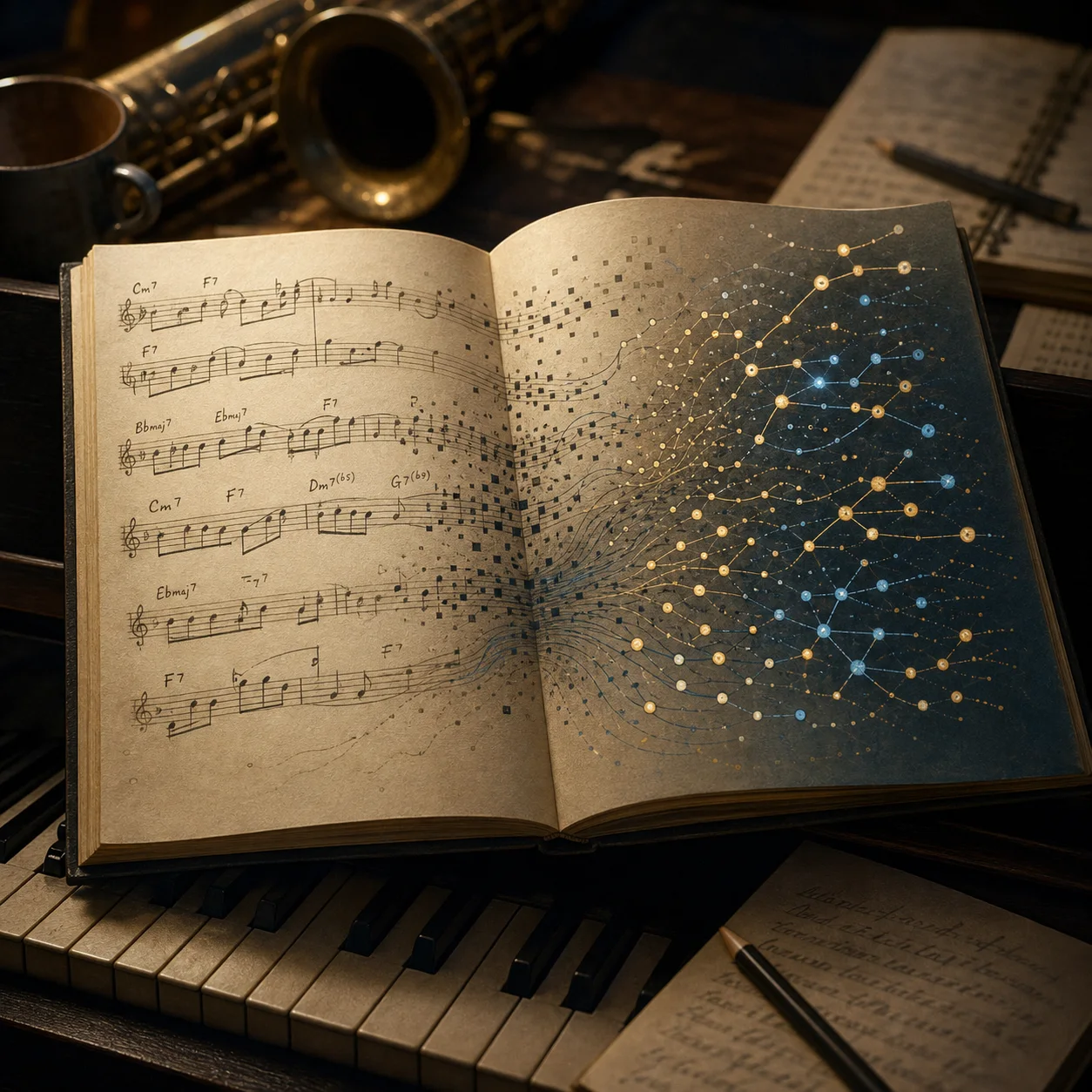
The prompt as open score: it does not fix every note, but it defines a field of possibilities.
This is why the quality of the instruction matters so much. A vague prompt can still produce something, just as a weak theme can still be played. But the result tends to reveal the poverty of the frame. Good composition does not eliminate freedom. It gives freedom something to push against.
There is also an ethical side to composition. Whoever defines the frame decides what counts as possible. A bad frame can make a rich answer impossible before the first note appears. A prompt can ask for clarity and receive simplification. It can ask for force and receive exaggeration. It can ask for neutrality and receive the ideology of whoever thinks their own position is neutral.
Jazz musicians know that the tune is never innocent. The form invites certain movements and discourages others. AI work should be read the same way: before judging the output, one has to look at the structure that called it into being.
Improvisation
Improvisation is not doing whatever occurs to you.
It is disciplined response.
The jazz musician listens to the chord, the drummer, the room, the memory of the tune, the previous phrase, the body of the instrument and the expectation of the next bar. The solo is invented, yes, but it is invented inside a web of obligations.
AI also responds inside obligations, though of a different kind. Context window, training patterns, system instructions, user prompt, probability, previous messages and safety constraints shape what can appear. The model does not improvise as a subject, but the output is not a fixed retrieval either. It is generated in the encounter.
That is where the comparison becomes useful.
Not because AI has soul.
Because both processes show that creation is often a relation between memory, rule and situation.
The difference is that the musician can hear the room and be changed by it. The model registers context, but it does not inhabit a scene. It has no body in the room, no fear of boring the audience, no memory of having failed before these listeners, no shame at repeating a cheap phrase. That absence does not make it useless. It defines where human judgment has to remain awake.
Rhythm
The most important thing is not always the note.
Sometimes it is the entrance.
Sometimes the delay.
Sometimes the silence.
Sometimes the decision not to fill the measure.
Rhythm is not just speed: it is knowing when to enter, how long to stay and where to leave air.
AI systems tend to answer too quickly and too much. They are built to produce. They do not feel the embarrassment of overplaying. They do not know that a pause can be an argument. They do not know that silence can protect a phrase.
The user has to bring rhythm.
The editor has to bring rhythm.
The writer has to decide when the machine should enter and when it should stay quiet.
That is why faster tools can produce slower responsibility. If every draft appears instantly, the temptation is to mistake availability for readiness. Jazz offers the better rule: the fact that one can play does not mean one should. The fact that the model can answer does not mean the answer has earned a place in the piece.
Cadence
Cadence is not ornament.
It is thought moving through time.
A sentence can be correct and dead. A paragraph can be clear and still have no pulse. A melody can contain the right notes and still fail because it arrives too squarely, repeats too eagerly or resolves too soon.
This is one of the places where AI reveals both its power and its limit. It can generate fluent cadence. It can imitate the surface of style. It can produce a passage that seems to know where it is going.
But cadence is not only fluency.
It is decision.
It is knowing what should remain rough, what should break, what should not be polished away. The model often wants to smooth. Jazz often teaches the opposite: keep the tension alive.
Multiple actors
Jazz is rarely the heroic solitude of one genius.
Even the solo is collective. The bass suggests a path. The drummer opens or closes a door. The piano leaves space or blocks it. The audience changes the room. The tradition plays through everyone.
AI work is also multiple. There is the model, the prompt, the dataset, the interface, the platform, the user, the editor, the institution, the economic model and the final reader. Treating the output as if it came from one isolated point hides the apparatus that made it possible.
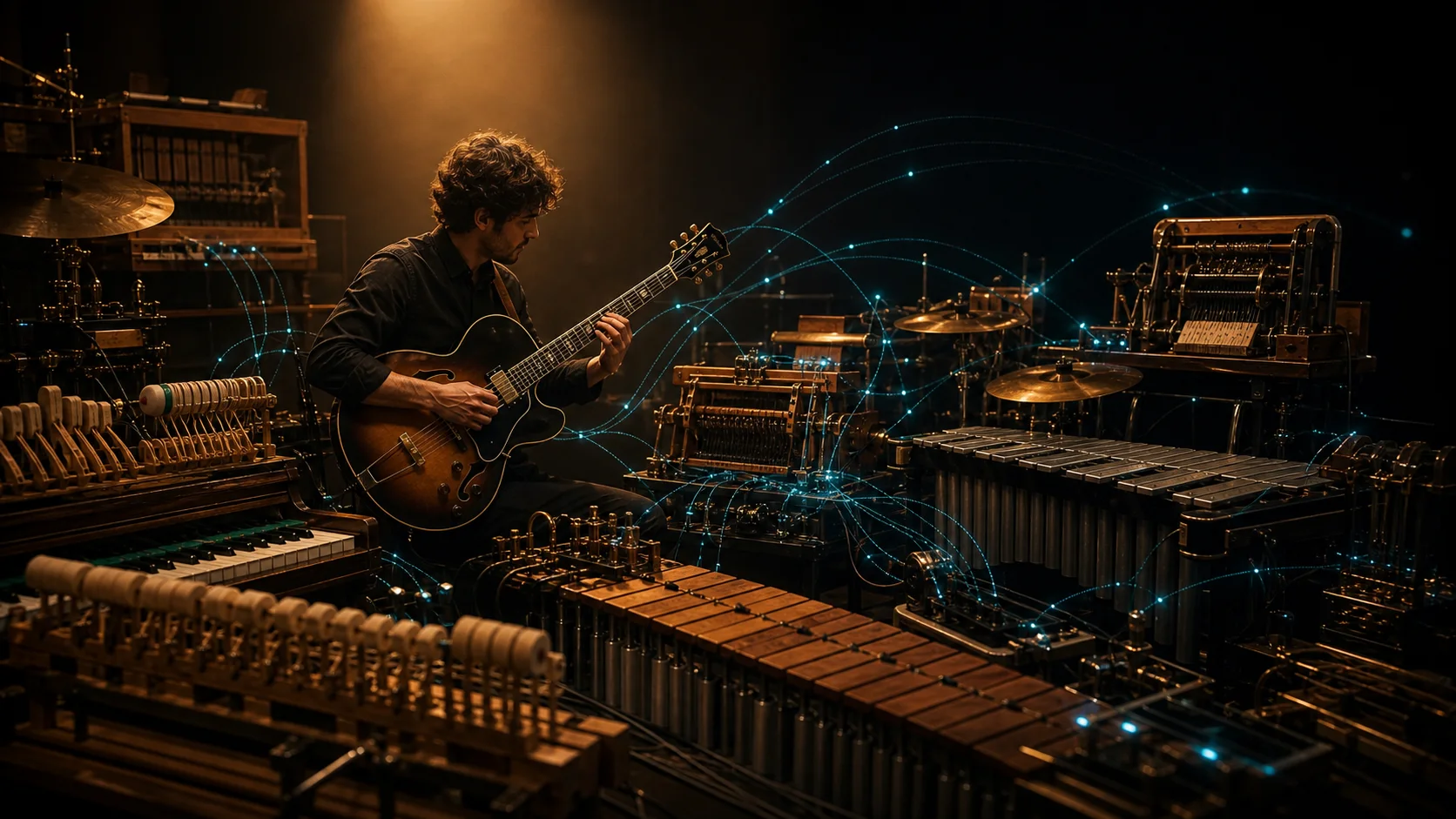
Automation does not eliminate direction: it moves craft toward system design, listening and decision.
Watching an automated musical system makes the point visible: the machine can execute, but direction remains a form of listening.
The question is not whether there are many actors.
The question is who is responsible for the form they produce together.
This matters because contemporary technology often hides ensembles behind singular names. A platform appears as a button. A model appears as a voice. A product appears as convenience. But behind it there are labor conditions, data decisions, moderation policies, energy costs, corporate priorities, interface choices and legal terms. Jazz makes the ensemble visible. AI often makes the ensemble disappear.
An honest practice has to restore the ensemble.
Long solos
Generative systems have a weakness that resembles a bad solo: they can keep going after the idea has ended.
The phrase continues.
The paragraph expands.
The example multiplies.
The explanation explains itself again.
Abundance starts to look like confidence.
Jazz knows this danger well. A long solo can build architecture, but it can also become self-indulgence. Duration is not depth. Variation is not development. More notes do not mean more music.
The same rule should govern AI-assisted writing.
If the machine offers ten options, nine may be a distraction.
If it writes five paragraphs, one may be alive.
If it explains everything, perhaps it has understood nothing about the necessary cut.
Creativity
The debate about whether AI is creative usually gets trapped in a bad alternative.
Either the machine is a new artist.
Or it is only theft and statistics.
Both positions can flatten the problem.
Jazz helps because it refuses the myth of creation from nothing. Every improviser works with borrowed material. Standards, riffs, quotations, habits, scales, records heard a thousand times. The question is not whether the material has a past. It always does.
The question is whether something happens with it.
Whether the inherited phrase is merely repeated or transformed.
Whether the response understands the room.
Whether a risk appears.
AI can produce surprising combinations, but surprise is not yet judgment. It can generate novelty, but novelty is not yet necessity. The creative value of an AI-assisted process depends on the human and institutional decision that frames, selects, cuts, contradicts and answers for it.
The romantic myth of the isolated genius never described jazz very well. Jazz is memory in public. It is individual phrasing inside collective inheritance. That is useful for thinking about AI because it prevents two symmetrical mistakes: believing that every generated variation is a miracle, or believing that every use of previous material is theft.
The real question is transformation.
What changed because this person, in this situation, with this tool, made this decision?
If the answer is nothing, the output may be fluent but culturally dead.
The error
Jazz has a special relation to error.
A wrong note can stay wrong.
It can also become the beginning of a new phrase.
That does not mean every mistake is genius. It means that music can metabolize accident when there is listening.
AI errors are different. A hallucinated source, a false fact, a generic phrase or a confident invention does not become interesting by being wrong. It becomes a liability unless someone notices, checks and transforms the process.
Here the analogy reaches its limit.
The jazz musician can turn a slip into form because the musician hears the slip and decides what to do next.
The model does not hear itself that way.
The human has to listen.
And listening is not a decorative afterthought. It is the main labor.
In a good band, listening decides whether a mistake becomes a path or remains a mistake. In AI-assisted work, listening decides whether an output becomes material or remains waste. That listening includes verification, but it is larger than fact-checking. It is also hearing tone, proportion, excess, cowardice, borrowed authority and the places where a sentence sounds intelligent because it has avoided the difficult part.
A decisive difference
There is one decisive difference.
Jazz musicians are accountable to other musicians, to the audience, to the history of the form, to the body of the instrument and to the phrase they just played.
AI is not accountable.
It does not blush.
It does not know when it has cheapened a line.
It does not care whether the room has changed.
That is why the comparison should not end in fascination. It should end in method. If AI resembles jazz in the way it works with memory and variation, then using it well requires the virtues of a good musician: listening, restraint, timing, knowledge of tradition, courage to cut, and the capacity to stop.
Those virtues are not technical decorations around the tool. They are the condition for the tool not to flatten everything it touches.
Without listening, AI becomes noise with grammar.
Without restraint, it becomes abundance without form.
Without tradition, it becomes style without memory.
Without the courage to cut, it becomes a solo that never ends.
That is not a minor danger. The culture around AI often rewards the visible surplus: more versions, more speed, more outputs, more “content.” Jazz reminds us that maturity can look like subtraction. The best phrase may be the one that arrives late. The best answer may be the one that refuses the premise. The best use of a generative tool may be to discover what should not be generated at all.
So the analogy is not decorative. It is practical. Use the machine as one more player only if someone is listening to the band.
Possible closing
AI can improvise only in a technical sense.
It can produce variations.
It can respond to context.
It can surprise.
But it does not know what it has done.
Jazz teaches that form is not only production. It is listening under pressure.
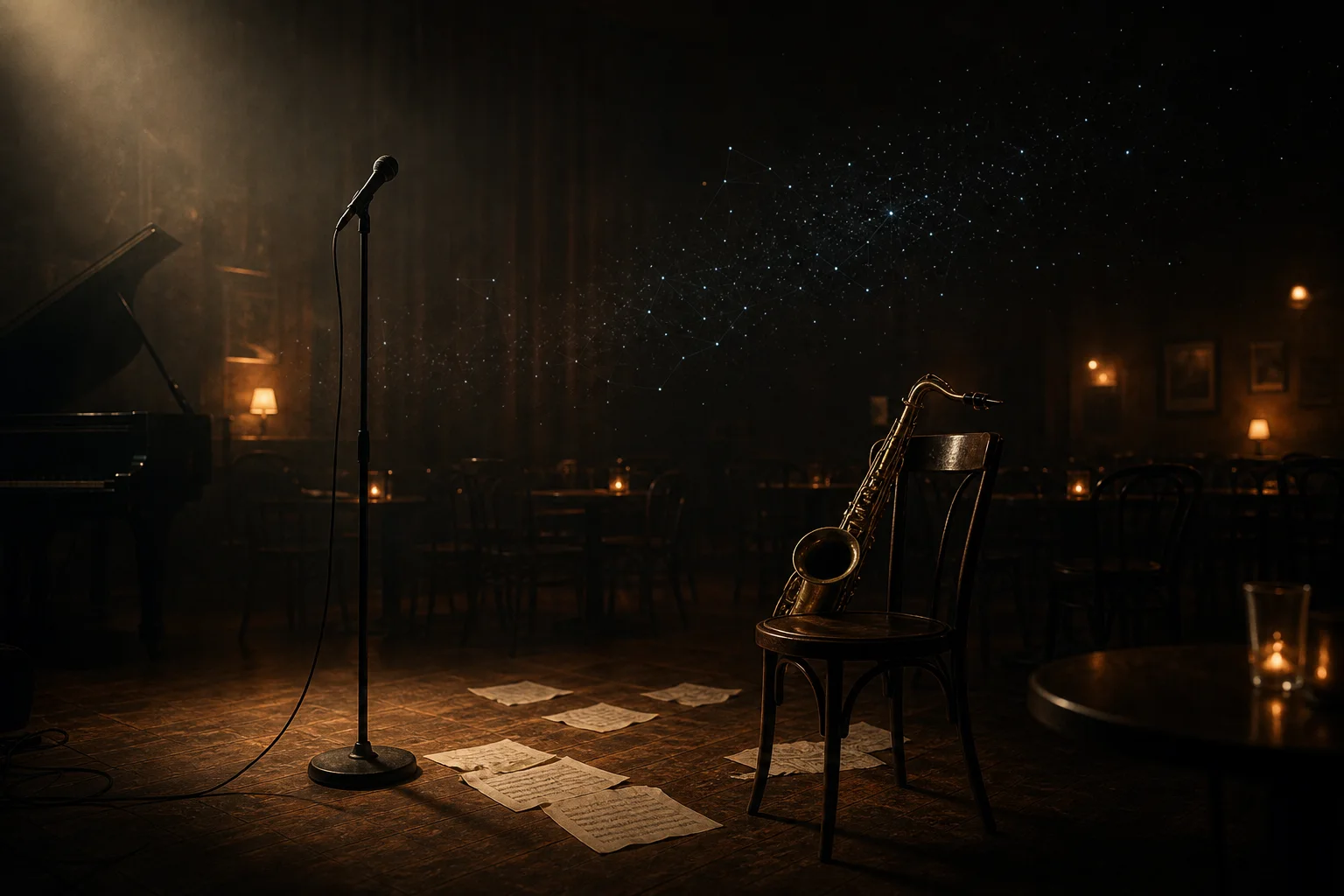
An interesting intelligence also knows how to be silent.
The best use of AI may not be the loudest one.
It may be the one that knows when to enter, when to leave space and when to let the human ear decide.
That is why jazz is a better analogy than the usual metaphors of engines, assistants or factories. It does not let us forget time. It does not let us forget the body, even when the system has no body. It does not let us forget that intelligence can fail by excess.
The machine can produce the next phrase.
The musician, writer or editor still has to know whether the phrase should be played.
And that decision is where the whole comparison becomes useful. Not in claiming that AI has become jazz, but in remembering that production without listening is not creation. It is output.
The difference is small in words and enormous in practice.
It is the difference between filling time and making music.
For writing, the equivalent is the difference between filling a page and finding a form. AI can fill the page with astonishing ease. The form still has to be heard, tested and accepted by someone responsible for the silence around it.
Martín Álvarez
@unfalsoguru