
If Jose Pedro Varela appeared today in a Uruguayan school, he would not begin by asking whether artificial intelligence thinks.
He would ask what kind of person we are forming when a machine answers.
He would ask who educates whom: the teacher educating the students, the platform educating the school, the market educating the State, speed educating attention, the automatic answer educating the human question.
And then, if he were still Varela and not an obedient statue made to say whatever suits us, he would do something rather uncomfortable: he would reform public school again.
Not to ban AI.
Not to fill classrooms with screens.
Not to turn every child into a prompt operator.
He would reform it to keep Uruguayan education from confusing access with formation, tool with thought, information with world and efficiency with humanity.
My impression is that Varela, in the age of AI, would defend a school that is more technical and more sensitive. More scientific and more artistic. More demanding with data and more attentive to the tone of a voice. More capable of using machines and less willing to obey them.
The Varelian reform of 2026 would not be a reform against technology.
It would be a reform against automatic school.
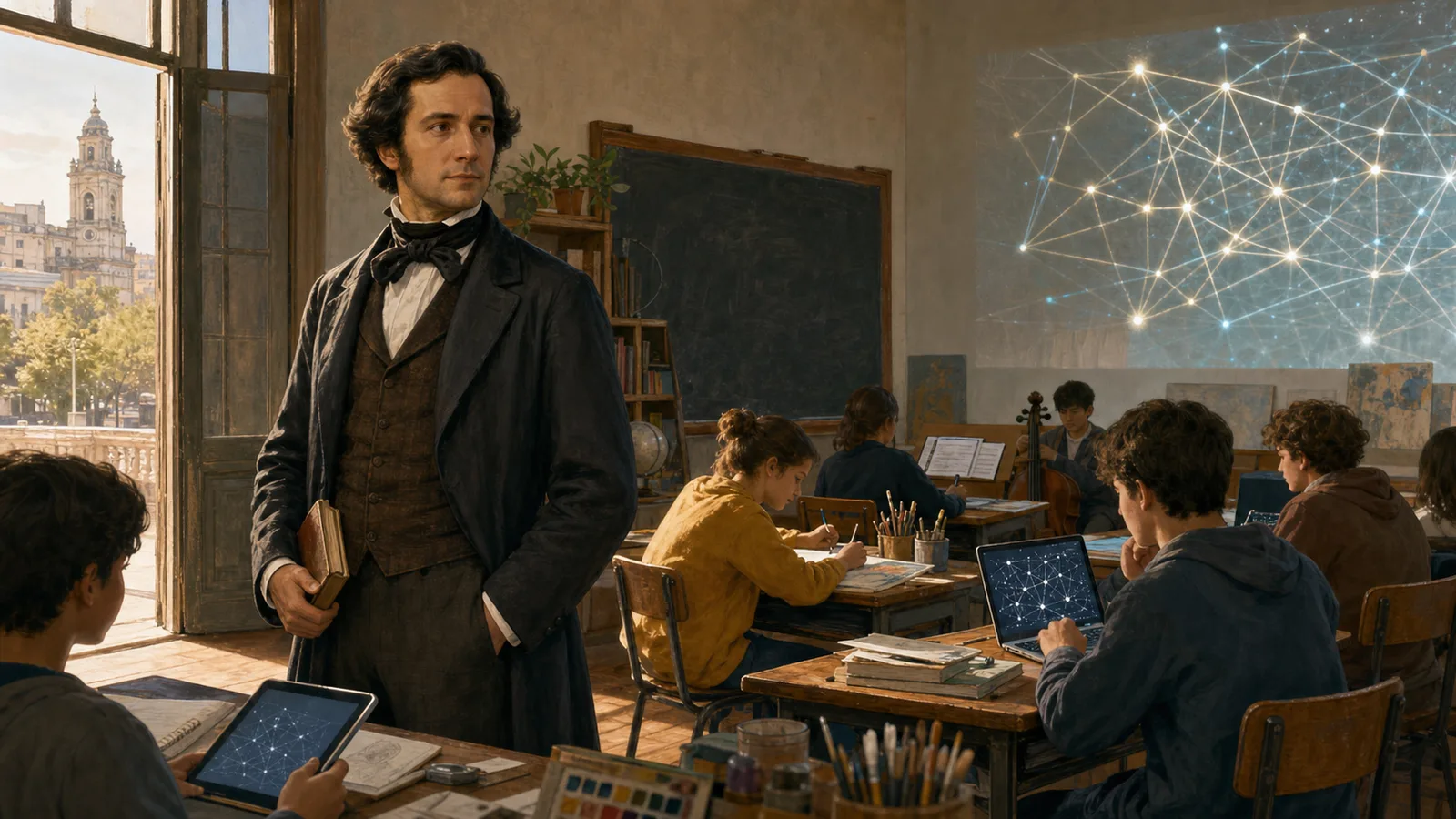
The question is not whether AI enters the classroom. It already has. The question is what authority it finds when it arrives.
He would not return to bless tablets
There is a foolish way of bringing national heroes into the present.
You put them next to a novelty and wait for them to smile. Varela with a tablet. Batlle with an app. Artigas with fiber optic internet. The operation is comfortable because the hero does not argue. He lets himself be photographed. He becomes a seal of approval.
But Varela was not important because he would have loved this or that technology.
He was important because he understood that education was a political infrastructure.
School was not a cultural luxury added to the country. It was a way of making a citizenship capable of existing in a modern country. Common education did not simply mean gathering children in a room. It meant building a shared floor of language, habits, intellectual discipline, coexistence, literacy and public authority.
That is why Varela would not return to ask how many computers there are.
He would ask what they do.
He would ask whether they increase intellectual freedom or dependence. Whether they expand the world or replace the world with an interface. Whether they help the teacher or reduce the teacher to a supervisor of screens. Whether they democratize knowledge or turn public school into a captive client of private platforms.
Uruguay already learned something about this through Plan Ceibal. Ceibal mattered because it attacked a concrete material inequality: access to computers, connectivity, resources, platforms and training. But its own public definition does not reduce it to delivering laptops. It speaks of digital inclusion, access to education and culture, programs that promote meaningful use, open educational resources and teacher training.1
The important word is this one: meaningful.
A computer alone does not educate.
It can open a library or distract from a class. It can be a laboratory or a toy. It can expand a question or replace it with consumption. It can help someone write or teach someone to copy. It can democratize knowledge or produce a new inequality between those who have cultural mediation and those who only have a device.
That is why Varela would not hand out ChatGPT subscriptions as if they were magic notebooks.
He would do something less spectacular and much harder: he would lay public foundations for thinking about AI, discussing it, using it, turning it off and answering for it.
The Varelian question would not be: do we have AI in education?
The question would be: do we have enough education for AI?
That changes everything.
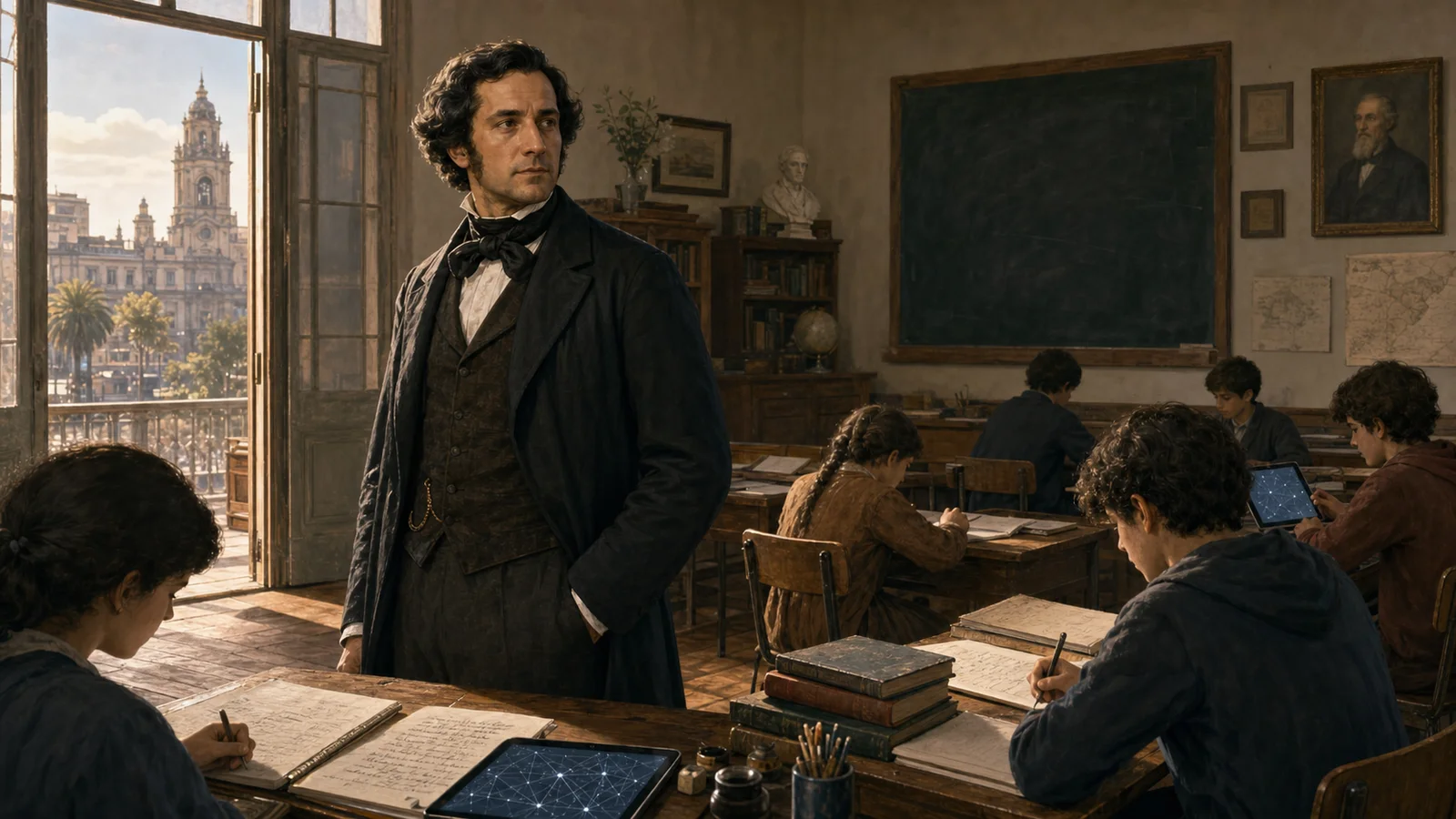
A technology is not blessed: we ask what it does to attention, freedom and the pedagogical bond.
Because generative AI brings an enormous promise and an equally large threat. It can help a teacher prepare activities. It can help summarize texts, create variants, adapt assignments, translate, correct, simulate debates, explain concepts, organize materials and open paths. It can also produce false answers in a confident tone, impoverish writing, facilitate plagiarism, generate dependence, capture data, replace conversation with download and allow a student to submit an assignment without having gone through any difficulty.
In Uruguay this is no longer futurism. According to ANEP and Ceibal, three out of four surveyed teachers say they use AI to generate educational or pedagogical proposals.2 The tool has already entered through the everyday door, not through a grand national reform. It entered through teacher need, curiosity, fatigue, experimentation, availability and environmental pressure.
Varela would see a classic situation there: reality moved before the institution.
And when reality moves before the institution, the strongest actor usually educates first.
Today the strongest actor is not necessarily the priest, the rural boss or the local caudillo.
It may be a platform.
It may be a cloud provider.
It may be a model trained far away from the Uruguayan school, with opaque criteria, implicit values, commercial limits and a huge capacity to look neutral.
The nineteenth century had catechisms.
The twenty-first century has terms of service.
What Varela actually reformed
It is worth returning for a moment to the historical Varela so we do not invent just anything.
Jose Pedro Varela was born in 1845 and died in 1879. He lived briefly, but managed to produce a decisive intervention. Along with others, he founded the Society of Friends of Popular Education in 1868. He traveled, read foreign pedagogical experiences, engaged with the debates of his time and wrote two central works: La educacion del pueblo and La legislacion escolar. Uruguay’s Ministry of Education and Culture also recalls his intellectual contact with Sarmiento, Herbert Spencer, Horace Mann and Norman Calkins, an author associated with the so-called object lessons.3 Autores.uy preserves and links to a digital edition of La educacion del pueblo, still a key piece for reading the Varelian program without depending only on school legend.4
The reform of 1877 was not merely a slogan. Law 1350 established that primary education would be compulsory and free, and organized that service institutionally.5 The trilogy we later learned as the Varelian mark - free, compulsory and secular - did not appear as moral decoration. It was an architecture.
Free, because ignorance could not depend on the pocket.
Compulsory, because education could not be left to family chance, local whim or the force of habit.
Secular, because public school should not belong to a particular dogma.
That last point is often reduced to religion, and it is understandable why. In the nineteenth century, the dispute over religious authority in civil life was decisive. But if secularism is taken seriously, it is not only anticlericalism. It is a theory of public authority: the school of the common cannot be colonized by a private truth that demands obedience before the question.
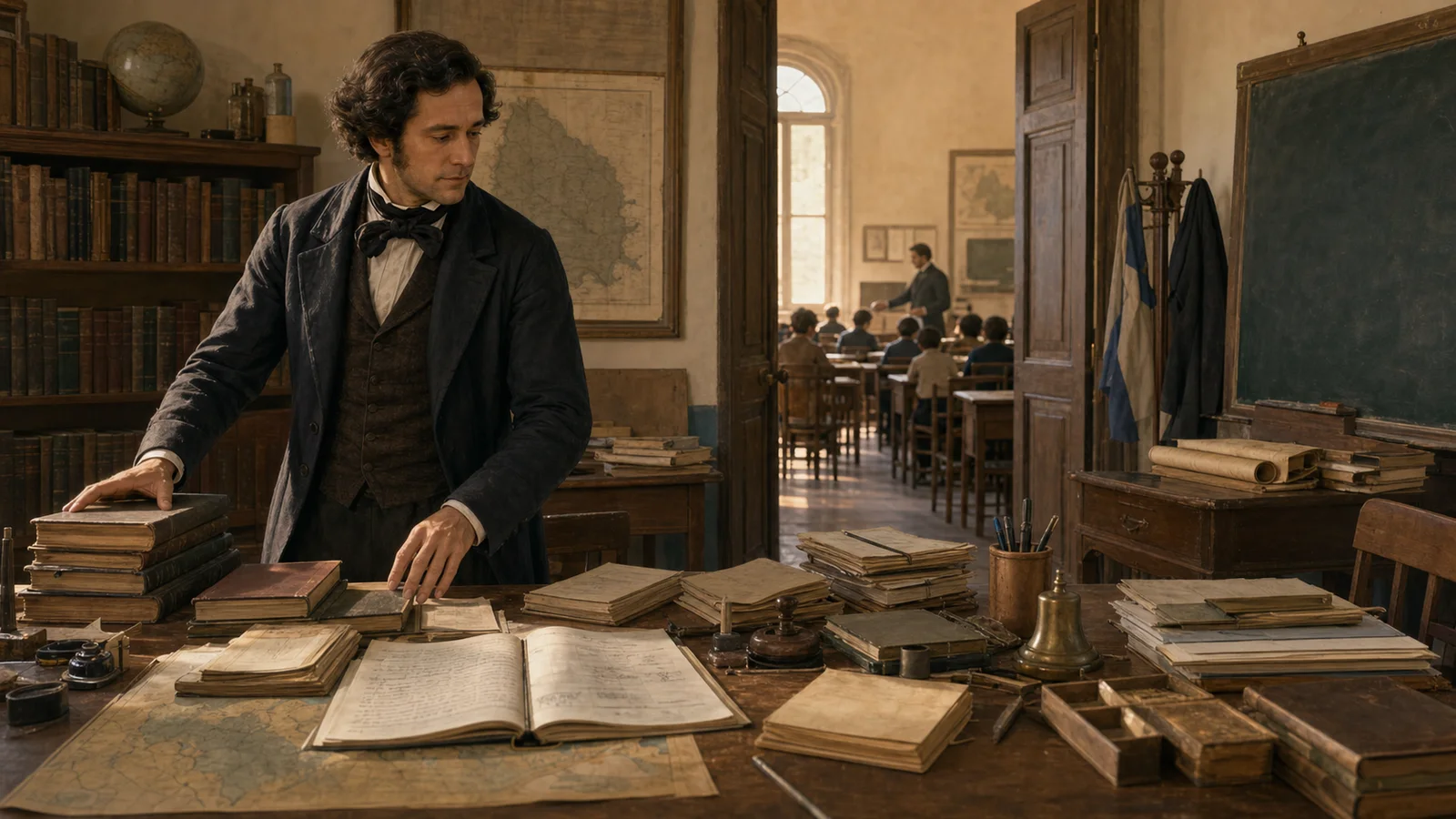
The reform was not a loose slogan. It was an architecture: free, compulsory and secular schooling, method and common school.
Translated into 2026, secularism does not end with removing the catechism.
It also requires that school not kneel before the technological catechism.
The historical Varela was a son of his century. He believed in progress, reason, science, civilizing discipline and an idea of modernity that we must now read with distance. It is not useful to turn him into a democratic saint without uncomfortable remains. His project also participated in a civilizing matrix that could look at certain popular forms of life with superiority.
But his institutional core remains powerful: when a society changes, school cannot merely repeat old habits. It has to produce citizenship for the new material world.
That is where the analogy appears.
In 1877, the problem was a republic that needed literacy, civil order, teachers, method and common school.
In 2026, the problem is a republic that needs algorithmic literacy, critical sensitivity, trained teachers, pedagogical sovereignty and common school in the face of digital infrastructures it did not democratically choose.
Varela would not ask whether AI is good or bad in the abstract.
He would ask whether public school has enough power to turn it into a tool, and not into a destiny.
AI as the new catechism
A catechism is not only a small religious book.
It is a form of answer.
Question.
Correct answer.
Repetition.
Authority.
Period.
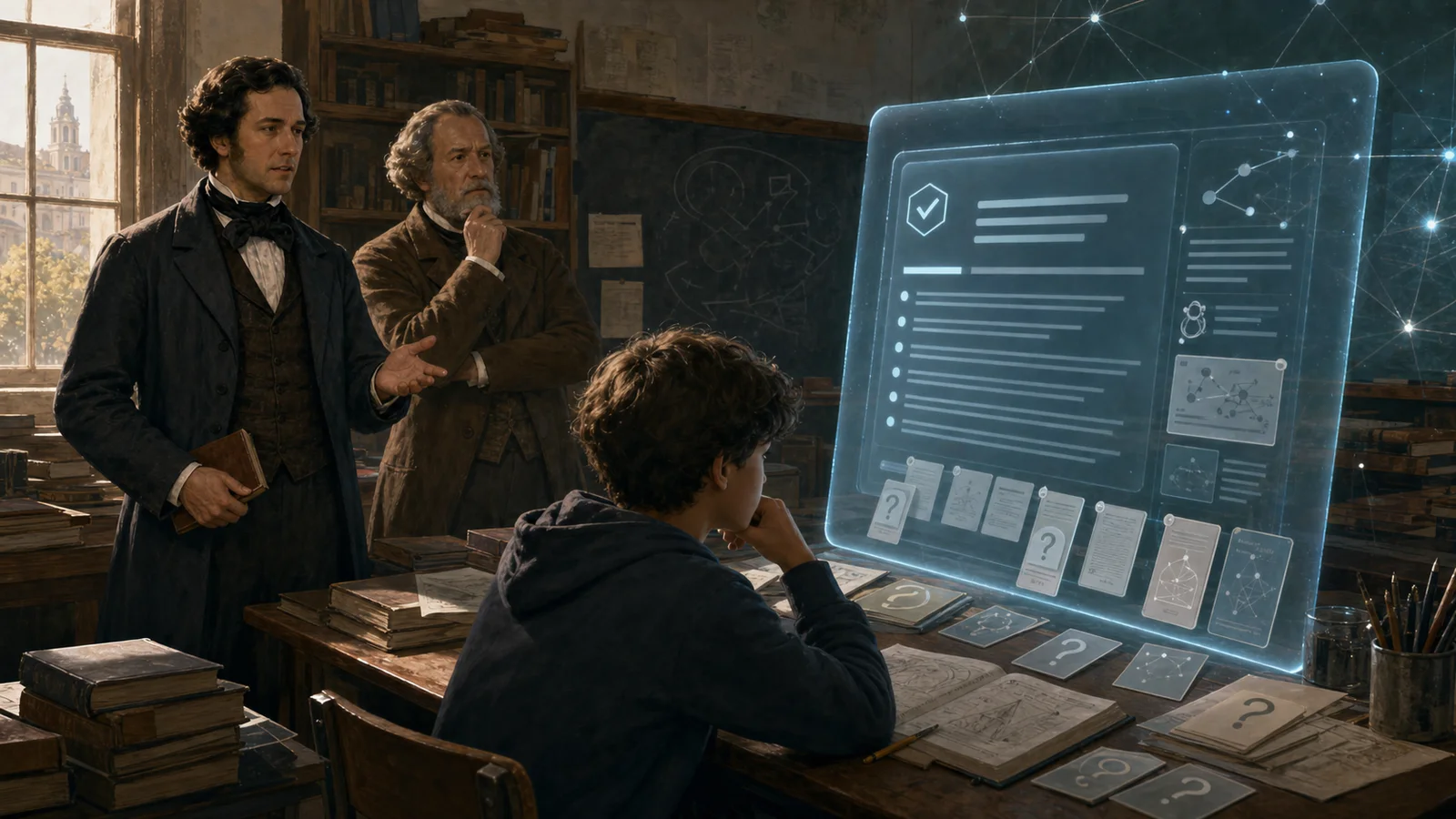
The school of AI cannot teach obedience before orderly answers. It has to teach how to verify apparent authority.
Generative AI has something disturbingly similar when used badly. Not because it is religious, but because it can return an orderly answer before the student has built a question of their own. It can sound clear before there is thought. It can offer an explanation before there is experience. It can turn difficulty into paperwork.
In “Sensitivity is not an optional subject” I wrote that AI can produce answers, but it cannot decide for us which questions deserve to be asked. In a Varelian key, that sentence becomes a school program.
The school of AI cannot limit itself to teaching students to prompt a machine better.
It has to teach them not to accept any answer as if it came from an authority.
That requires a new literacy. Knowing how to read letters is not enough. Knowing how to use an interface is not enough. Knowing how to write an elegant prompt is not enough. Algorithmic literacy must include, at minimum, five capacities:
- understanding that a model does not know the way a person knows;
- distinguishing fluency from truth;
- verifying sources and reconstructing procedures;
- recognizing biases, omissions, frames and apparent authority;
- deciding when not to use a tool.
That last point is central.
A school colonized by AI will teach students to use AI for everything.
A formed school will also teach when to turn it off.
UNESCO has been insisting on a human-centered approach, with data protection, human supervision, equity, inclusion and limits of age and context for generative AI in education.6 Its competency frameworks for teachers and students, published in 2024, organize the issue around ethics, critical thinking, foundations of AI, design, responsible use and a human view of technology.7
That is not a bureaucratic footnote.
It is the center of the matter.
Educational AI should not only ask how to personalize exercises.
It should ask what kind of subject it produces.
If it produces a student who waits for the machine to complete every uncertainty, it has failed.
If it produces a student capable of arguing with a machine, detecting its errors, using it to expand an investigation, contrasting it with books, asking it for objections, writing better, correcting more, looking again and taking responsibility for what they submit, then it begins to make sense.
In “The tool does not sign” I defended a distinction that becomes pedagogical here: the adult question is not only whether AI was used, but what was done with it. School should teach that early. Not purity. Method. Not panic. Judgment.
The student of the twenty-first century does not need to learn to pretend they did not use tools.
They need to learn to answer for the use of their tools.
Sensitivity is not decoration
Here comes the part that matters most to me.
If Varela were alive today, I think the most radical reform would not be to create a subject called artificial intelligence.
It would be to put sensitivity at the center.
Not sensitivity as brochure tenderness.
Not sensitivity as artistic recess.
Not sensitivity as a colorful mural to compensate for the hardness of mathematics.
Sensitivity in the strong sense: the capacity to perceive relevant differences. An ear for tone. Attention to nuance. Patience to look. A body able to listen. Imagination to enter another life. Memory not to confuse novelty with truth. Language to name what is happening before an assignment captures it.
Sensitivity is not the opposite of method.
It is a condition of method.
A scientist without sensitivity looks badly. A doctor without sensitivity listens badly. A programmer without sensitivity automates harms they do not perceive. A judge without sensitivity turns the norm into stone. A teacher without sensitivity cannot distinguish disinterest from fear. A journalist without sensitivity turns another person’s pain into material. A citizen without sensitivity is at the mercy of the first story that organizes their anger.
Read superficially, Varela might seem like a natural ally of scientific school against art.
But that opposition is false.
The object lessons that influenced modern pedagogy sought something very concrete: that the child observe, compare, name, distinguish, relate. They were not sentimentalism. They were an education of perception. The fight against mechanical memory was not solved with more data, but with organized attention.
There is a door there for reading him today.
The sensitivity we need in the age of AI is not a soft subject.
It is perceptual literacy.
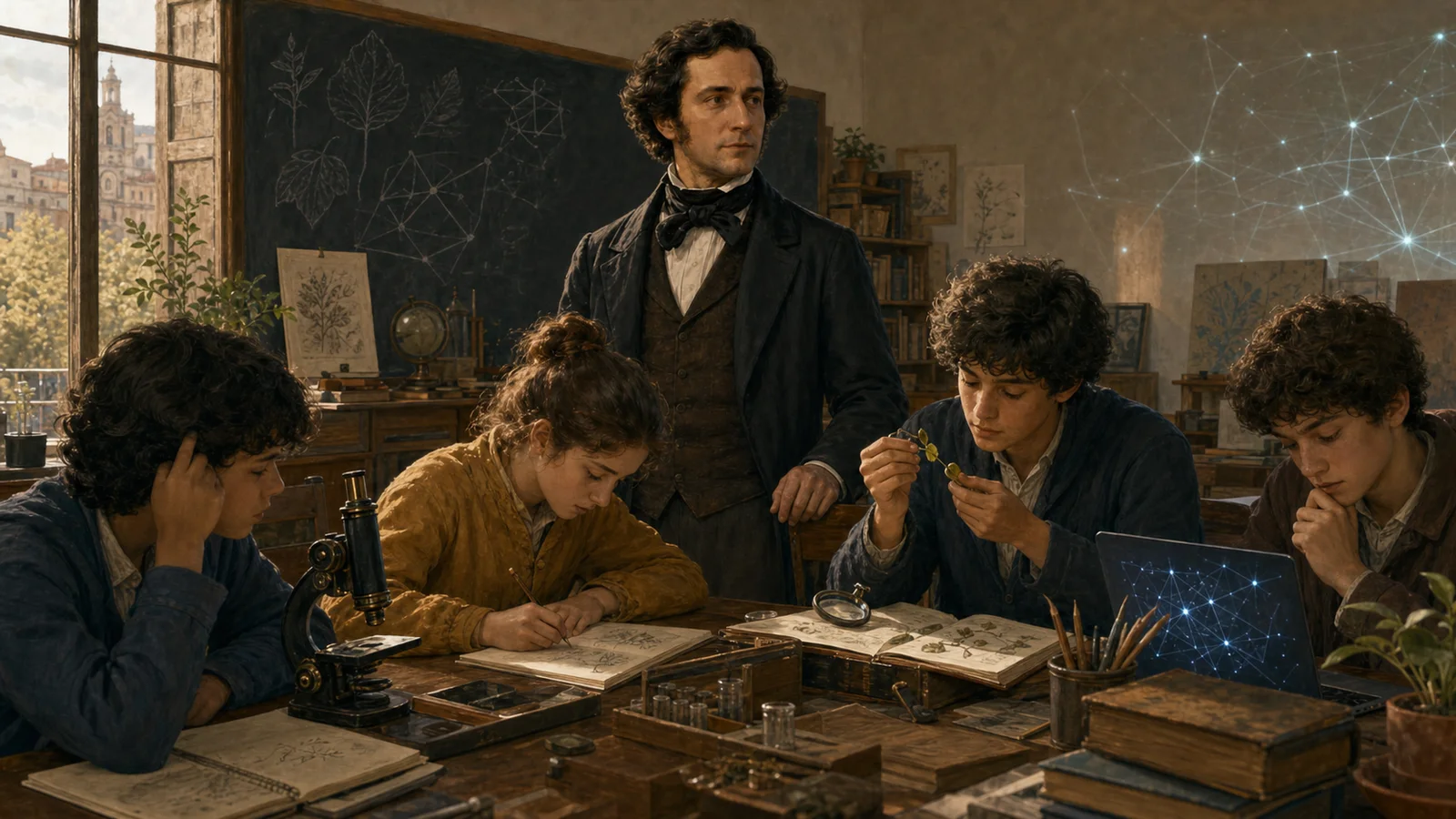
Sensitivity does not soften method. It teaches method what to look at, what to listen to and which difference matters.
In “Method against instinct” I wrote that suspicion is not a method. Education should teach exactly that. Suspecting an automatic answer is not enough. You have to know how to verify it. But the reverse is also true: method without sensitivity does not know what to look at. It can audit a sentence and fail to understand the humiliation it contains. It can measure performance and miss the loss of desire. It can count attendance and not hear why a child stopped coming.
ANEP’s 2024 Primary Education Monitor, when presenting challenges around attendance and repetition, reminds us that Uruguayan school has material problems that do not disappear because we talk about AI.8 PISA 2022 also showed that Uruguay cannot afford a decorative discussion: average performance was below the OECD average and, in mathematics, only part of the students reached the basic level of proficiency.9
So this is not about choosing between sensitivity and hard learning.
It is about understanding that without sensitivity there is no hard learning that can be sustained democratically.
A country can buy tools.
It cannot buy formed judgment.
That has to be cultivated.
Arts, reading, body
The school of AI should have more art, not less.
More music.
More literature.
More theater.
More drawing.
More dance.
More photography.
More conversation about images.
More manual work.
More open libraries.
More reading aloud.
More slow writing.
More listening.
This may sound scandalous precisely when everyone is asking for programming, robotics, data, science and digital skills. But the idea is not to remove science. It is to keep school science from becoming training without a world.
In “Jazz and AI are very much alike” I worked through an analogy that serves school well: AI can generate variations, but it does not know how to listen the way a musician listens. Jazz teaches something a model imitates badly: when to enter, when to remain silent, when to sustain tension, when a note is too much. That is not ornament. It is temporal intelligence.
Music teaches how to hear relations.
Literature teaches how to inhabit consciousnesses that are not one’s own.
Theater teaches body, scene, point of view, voice, conflict.
Drawing teaches that looking is not quick recognition, but staying.
Photography teaches framing, waiting, decision, responsibility for the visible.
Craft teaches the resistance of matter.
Reading teaches a duration that the interface tends to destroy.
Writing teaches that thinking is not downloading an answer, but struggling with a form.
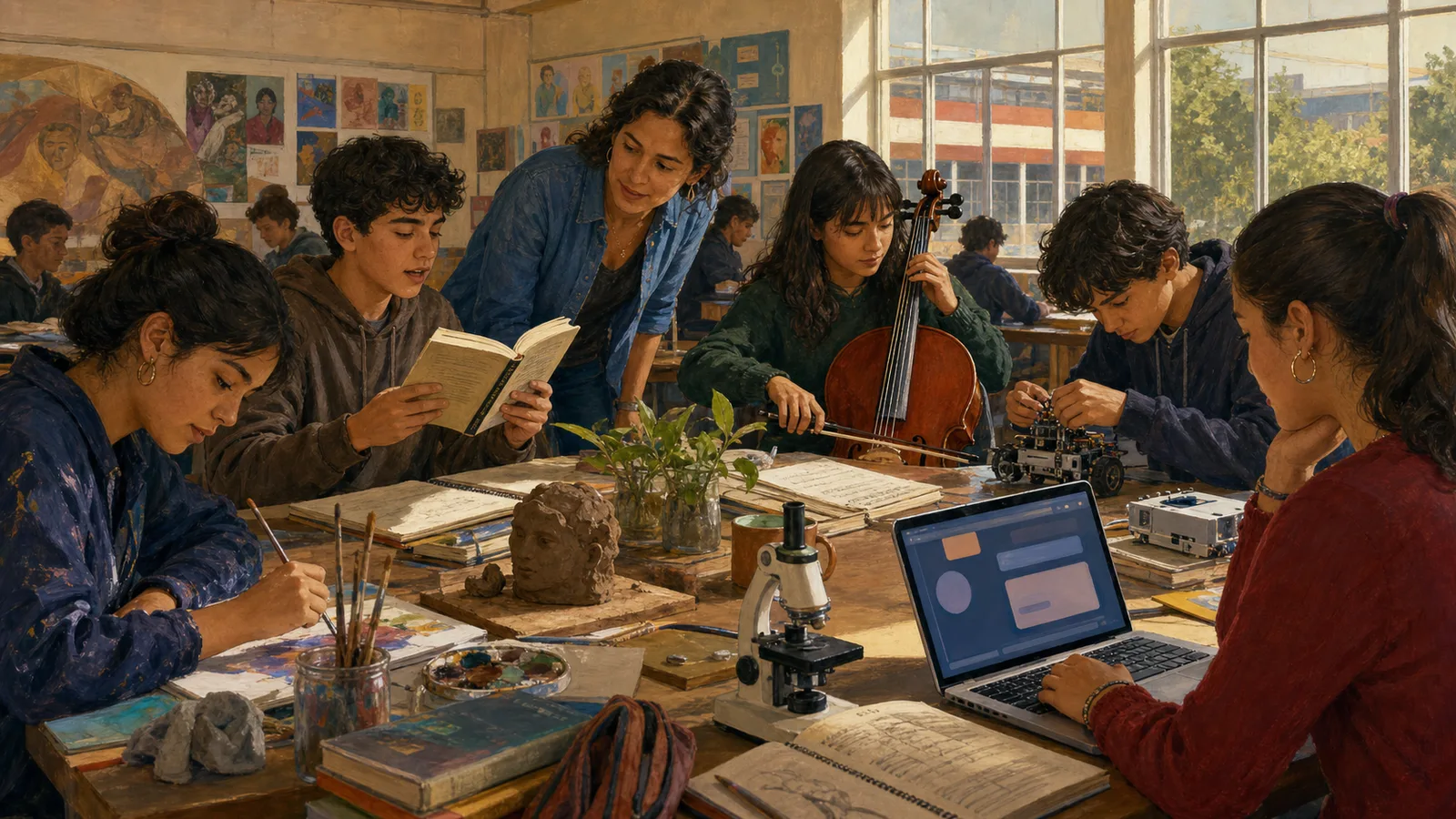
The common school of AI should not separate arts and technique. It should teach what each one does when they sit at the same table.
UNESCO approved in 2024 a global framework for culture and arts education that seeks to place cultural and artistic education inside broader educational policies, not as a side luxury.10 The OECD, from a less lyrical register, also reviewed evidence on arts education and warned against justifying art only through instrumental transfers to other areas.11
That warning matters.
The worst defense of art is saying that it serves to improve mathematics.
Sometimes it may help.
But art does not need to ask permission as disguised cognitive training.
Art matters because it forms experience. Because it opens worlds. Because it educates perception. Because it allows us to work through pain, desire, conflict, memory, absurdity, beauty, failure, rhythm, irony, body, community. Because it teaches that not all meaning appears as data.
Martha Nussbaum defended the humanities and the arts as conditions of democracy, not as a refined pastime.12 Rodo, with all his limits and elitisms, helps us remember that Latin America thought early about the danger of a life organized only by utility.13 C. P. Snow still helps us avoid turning science and literary culture into enemy tribes.14
A Varelian reform of 2026 would have to take that constellation and bring it down into the school schedule.
Not as an inspirational talk.
As budget, teaching hours, formation, instruments, libraries, rooms, workshops, assessment, territorial presence.
Art cannot be left for the child who already has a piano at home.
Literature cannot depend on whether there are books in the household.
Music cannot be a private privilege.
Sensitivity cannot be class inheritance.
If we really believe AI will automate a growing part of technical, repeatable, administrative and textual tasks, then public school has to democratize what is not so easily automated: attention, judgment, imagination, taste, responsibility, conversation, the desire to understand.
The problem is not a lack of screens.
The problem is that, when it comes to sensitivity, we let the family market act.
And the family market is brutal: it distributes books, languages, museums, music, travel, silence, time and confidence unequally.
Public school exists to dispute that distribution.
The teacher is not an operator
Varela did not reform only contents.
He reformed a teaching institution.
Without trained teachers, reform was paper.
That point is decisive in the age of AI. The administrative temptation will be to think that technology solves the problem of the teacher: if there are good adaptive contents, personalized assistants, automatic correction and AI-generated plans, then the teacher can become an efficient monitor.
That would be a defeat.
The teacher is not the human obstacle left between the student and the platform.
The teacher is the pedagogical authority that prevents the platform from becoming the whole world.
A formed teacher does not compete with AI in memory, speed or production of variants. The teacher competes in another zone: context, bond, classroom reading, interpretation of silences, situated demand, care for processes, invention of scenes, ethical judgment, construction of community.
AI can suggest an assignment.
The teacher knows whether that assignment humiliates, simplifies, bores, confuses or opens.
AI can explain a concept in five ways.
The teacher knows which of those ways works for that group, on that day, after that fight at recess, with that student who did not sleep, that girl who thinks she is incapable, that class that has become used to answering without reading.
AI can correct patterns.
The teacher can listen to a voice being born.
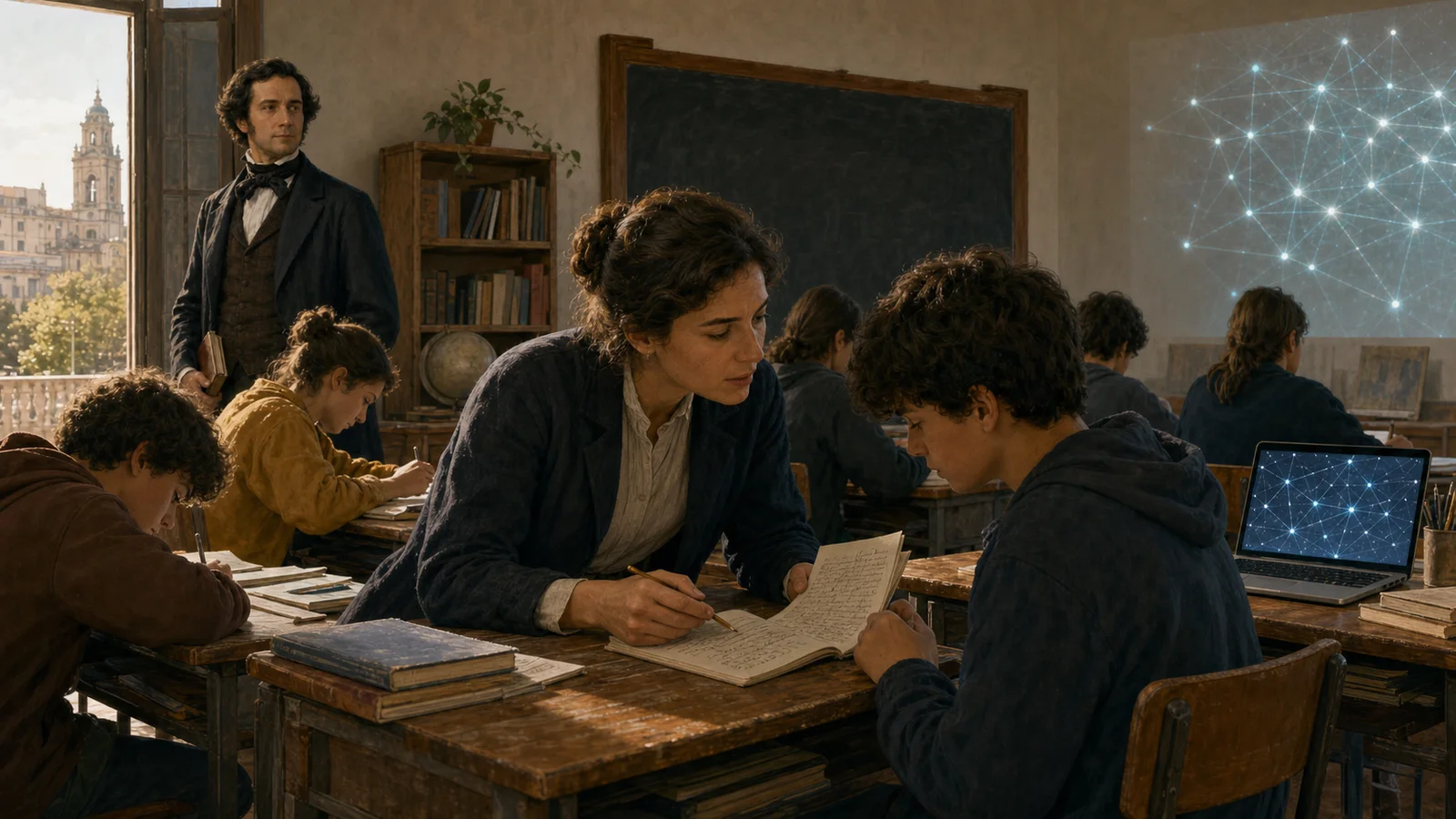
The tool can assist. Pedagogical authority remains with the person who reads the classroom and answers for what is taught.
That is why teacher formation should be the center of any reform. Training in tools is not enough. We have to form teachers capable of governing them.
That includes:
- foundations of AI, data and bias;
- privacy, children’s rights and safety;
- design of assignments that make copy and paste useless;
- assessment of processes, not only products;
- critical reading of automatic answers;
- writing with revision, logbook and oral defense;
- integration of arts, sciences and technology;
- care for the pedagogical bond;
- criteria for deciding when a tool helps and when it gets in the way.
Assessment also has to change.
A generic homework assignment has become too easy to simulate. Pretending nothing is happening will only produce hypocrisy. The answer is not to return to a police school, full of AI detectors that do not read either. The answer is to design better learning scenes: in-class work, process portfolios, research notebooks, oral conversations, defense of sources, collective projects, handwriting when it makes sense, public revision, successive drafts, relation to local materials.
School has to ask less “was this written by a machine?” and more:
Can you defend it?
Do you know where it came from?
What did you verify?
What did you change?
What did you not accept?
What did you learn that you did not know before starting?
What part is yours?
There Varela returns.
Not as nostalgia.
As method.
A Varelian reform for 2026
If I had to write the reform as a formula, I would say this:
common education for distributed intelligence.
Intelligence is no longer only in individual heads, books or institutions. It circulates among people, machines, archives, databases, platforms, sensors, networks, images, models and markets. Precisely for that reason, common school becomes more necessary. If intelligence is distributed unequally, inequality also becomes more sophisticated.
A Varelian reform of AI would have to translate the old principles like this:
| Varelian principle | Translation in the age of AI |
|---|---|
| Free schooling | Public access to connectivity, devices, safe models, books, libraries, instruments, workshops, museums and teacher time. |
| Compulsory schooling | No student graduates without algorithmic literacy, deep reading, sustained artistic experience and the capacity to defend their own work. |
| Secularism | Independence from religious, partisan, corporate and technological dogmas. School cannot be catechized by opaque platforms. |
| Method | Less mechanical memory, more observation, verification, writing, experimentation, conversation, revision and public proof. |
| Common school | A shared base that does not depend on neighborhood, family income, private device or inherited cultural capital. |
From there a concrete program would emerge.
First: algorithmic literacy from primary school.
Not so young children learn fashionable jargon. So they understand, with examples appropriate to their age, that machines classify, recommend, predict, order and make mistakes. That not every result is neutral. That their data matters. That a photo, a search, an audio and an assignment can enter circuits they do not see. That a beautiful answer can be false. That a machine does not replace the responsibility of the person who uses it.
Second: public AI or, at minimum, strong public governance.
Uruguayan school cannot naively depend on commercial tools without audit. AGESIC already sets out in the National AI Strategy 2024-2030 axes of governance, capacities, data, infrastructure, trust and responsible use, in addition to incorporating AI into formal and non-formal education.15 A Varelian reading would demand bringing that into the classroom with material force: evaluation of providers, protection of children’s data, traceability, transparency, contestable public procurement, authorized models, teacher formation and State capacity to audit.
Third: arts as a common trunk, not ornament.
Every school should guarantee sustained artistic practice. Not an occasional visit. Not a bulletin board for a ceremony. Real workshop. Real music. Real reading. Real theater. Real drawing. Real cinema. Real writing. Living libraries. Artists and mediators entering school, but also teachers formed to sustain that practice when the guests leave.
Fourth: school libraries and slow reading as national infrastructure.
In “Against the non-place: in praise of booksellers” I defended bookseller judgment against the silent accumulation of the infinite catalog. The same thing happens in school. Access to millions of texts is not enough. A school library with mediation is an institution of orientation. It teaches how to choose, abandon, return, compare, get lost and find. AI can summarize a book. It cannot replace the experience of going through it.
Fifth: assessment with defense, process and presence.
The school of AI must abandon part of its faith in isolated products. The process matters: drafts, notes, sources, decisions, errors, conversation. A student may use AI, but must be able to reconstruct what they did. That is not punishment. It is formation of authorship. The tool does not sign. The student should not sign without answering either.
Sixth: teachers with protected time.
No reform is possible if teachers are exhausted, full of bureaucracy and forced to learn tools on their own at night. Serious policy should give them institutional time to experiment, share materials, review cases, discuss dilemmas, build common criteria and produce open resources. Training without time is simulation.
Seventh: school as an open table of culture.
In the discussion about books, I insisted that the whole book has to be on the table. The same goes for education. A reform of public sensitivity cannot be made only among technologists, authorities and consultants. Teachers, students, families, librarians, artists, scientists, psychologists, social workers, universities, UTU, Ceibal, ANEP, the interior, neighborhoods and communities have to enter. AI is not only an issue of computer science. It is language, work, attention, desire, inequality and citizenship.
Eighth: platform secularism.
This deserves a name of its own.
Public school must be able to say no to a platform even if it is free. It must be able to demand that student data not be used for commercial training. It must be able to explain what system is used, with what limits, what risks it has, what it does with the data, who answers for harm. It must prevent the classroom from becoming an opaque laboratory for companies that present marketing as pedagogical innovation.
Ninth: the right to cognitive disconnection.
AI makes it easy to fill every silence. School has to defend times without automatic assistance: reading without a summary, writing without autocomplete, solving without an immediate hint, looking at a work without searching for an explanation, walking, drawing, discussing, getting a little bored, sustaining a question. Not out of nostalgia, but because attention is also trained in the absence of an answer.
Tenth: a new experimental normalism.
Varela understood that the teacher was an institution. Today we would need to create public pedagogical laboratories where teachers test uses of AI, arts and science with evidence, but without dashboard fetishism. Teacher-training schools, institutes, Ceibal, universities and communities could produce open resources, guides, cases, sequences, documented errors and ethical criteria. Not courses of fashion. Accumulated craft.

A reform does not begin with the tool. It begins with the table where a society decides what to do with it.
What he would not do
It is also useful to say what Varela would not do, or what a Varela seriously brought into the present should not do.
He would not launch a moral crusade against AI.
The historical Varela was not an enemy of modernity. He was a reformer who wanted to organize it. Prohibiting out of fear would be a poor reading of his impulse. School should not hide the tool that already organizes the world of work, information, culture and administration.
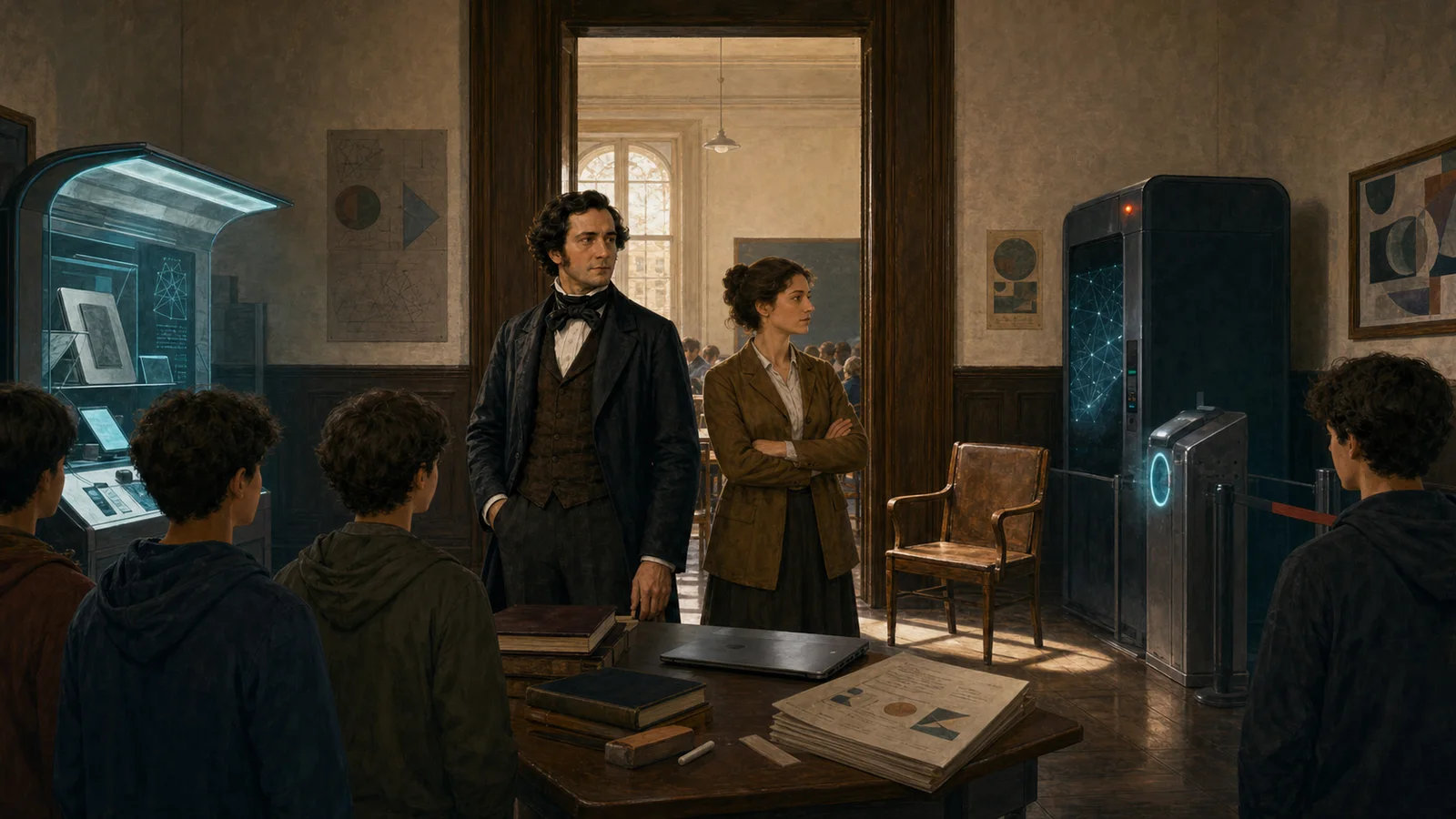
A public reform does not kneel before sellers of the future or turn fear into method.
He would not hand school over to sellers of the future.
A Varelian reform would not confuse innovation with licenses, dashboards, metrics and consulting phrases. It would distrust pedagogy packaged by those who make money measuring every gesture in the classroom.
He would not hand out ChatGPT subscriptions as educational policy.
He could buy tools, of course. He could negotiate access, create public models, integrate assistants, experiment with tutoring, open laboratories. But he would not call access without method a reform. A subscription is not equivalent to a school. The public question would not be how many accounts were activated, but what judgment was formed around them.
He would not reduce education to employability.
Training for work matters. Uruguay needs science, technology, trades, engineering, health, data, programming, production. But a school that only forms human resources impoverishes the republic. Public education does not exist only to supply the market. It exists to form people capable of living, arguing, voting, creating, caring, working, disobeying when appropriate and understanding the world they share.
He would not put arts as a reward for finishing the worksheet.
That is one of the gravest errors. First the important thing, then the expressive. First calculation, then music. First test, then theater. First performance, then sensitivity. No. If sensitivity is a form of intelligence, it cannot be left at the end of the line.
He would not replace teachers with automatic tutors.
There can be assisted tutoring, personalized support and useful tools. But the pedagogical relation is not solved like customer service. The student is not a user. School is not an app. The teacher is not technical support for a platform.
He would not let the AI detector become the police of thought.
Detectors fail, generate false accusations and push schools toward a culture of suspicion. School needs better assessments, not more paranoia. The question should not be how to catch the student, but how to design work where learning matters more than submitting.
He would not repeat 1877 as liturgy.
A useful counterfactual does not consist of saying Varela would be right about everything. It consists of using his reforming impulse to discomfort the present. If public school was an institutional answer to a changing society, then fidelity to Varela is not preserving his statue.
It is daring to reform again.
The school that can still answer
AI does not destroy education.
It undresses it.
It shows which school tasks were disguised repetition. It shows which assessments measured obedience. It shows which assignments could be solved without thinking. It shows which teachers were alone. It shows which students wrote to submit and not to understand. It shows which institutions confused technology with policy. It shows which families could compensate with private cultural capital for what school did not give.
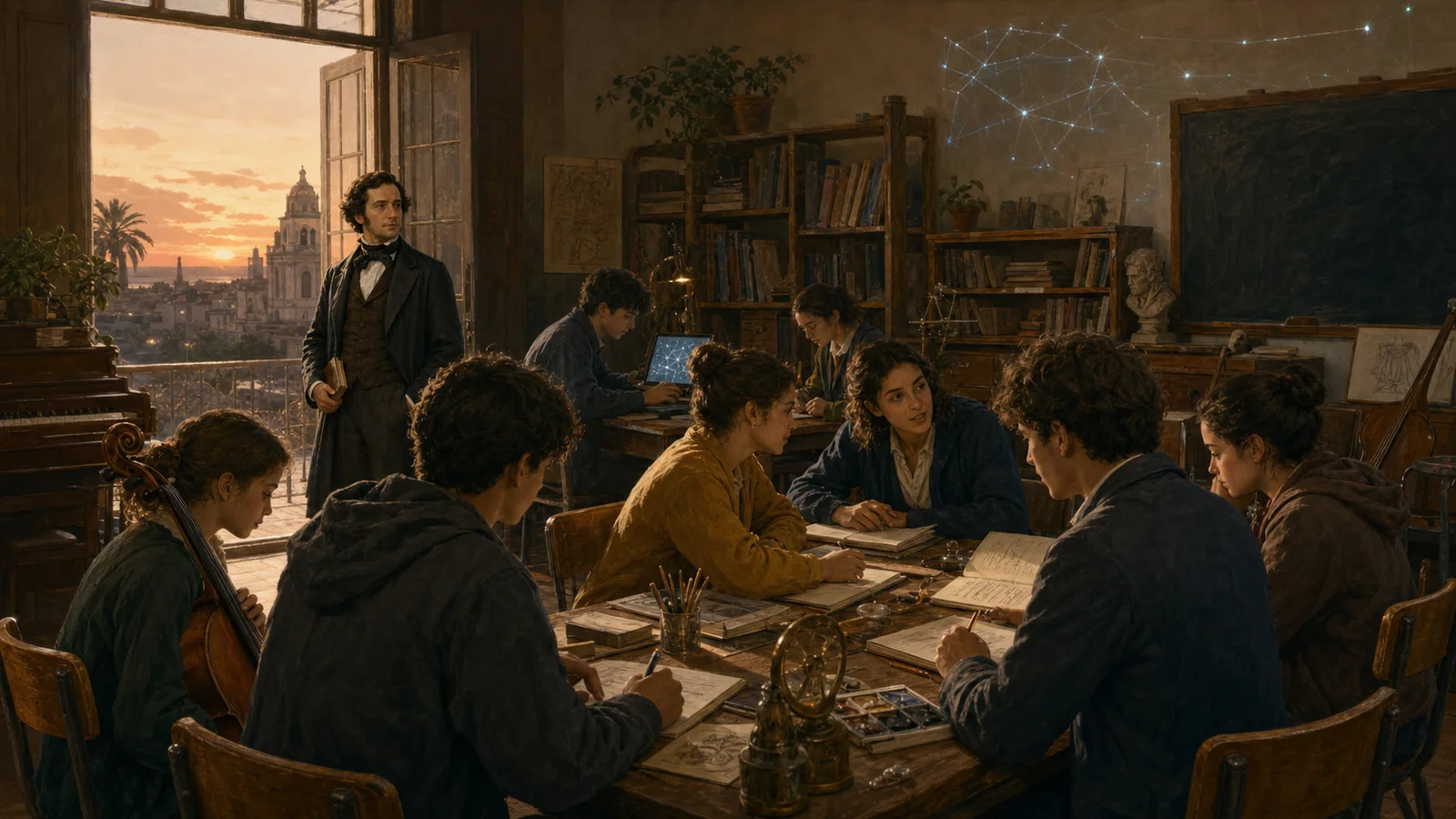
The answer is not to turn off the technical world. It is to build a school capable of answering it.
That is why the arrival of AI can be a catastrophe or an opportunity.
Catastrophe if school becomes more automatic than the machine.
Opportunity if it forces us to say again what we educate for.
Varela, I think, would not accept education reduced to training. Nor would he accept a humanist nostalgia incapable of understanding technique. He would seek a common school for a new age: public, demanding, sensitive, scientific, artistic, secular in the face of platforms, capable of forming citizens who use tools without becoming spiritual employees of those tools.
The reform would have to begin with a simple sentence:
every child has the right to an intelligence of their own surrounded by common intelligence.
That means books.
It means teachers.
It means science.
It means art.
It means AI when it helps.
It means silence when needed.
It means a library.
It means a song.
It means a screen that does not command.
It means a body that learns.
It means a school where the automatic answer is not the end of the question, but the beginning of a more difficult conversation.
Sensitivity is not an optional subject.
In the age of AI, it is the new common school.
Martín Álvarez
@unfalsoguru
Working references
Footnotes
-
Ministry of Social Development, “Plan Ceibal”, program record. The official description presents it as a digital inclusion policy for access to education and culture, with laptops, connectivity, open educational resources, training and meaningful-use programs. ↩
-
ANEP, “En Uruguay, tres de cada cuatro docentes utilizan IA para generar propuestas educativas o pedagogicas”, May 12, 2026. ↩
-
Ministry of Education and Culture, National Academy of Letters, “Jose Pedro Varela”. The page summarizes his biography, the Society of Friends of Popular Education, his works and his international pedagogical references. ↩
-
Autores.uy, “La educacion del pueblo”, record with a link to the digitization of Jose Pedro Varela’s work. ↩
-
IMPO, Law No. 1350, Public Instruction, Primary Education, enacted on August 24, 1877. The official summary states that it established compulsory and free primary education and regulated the organization of the service. ↩
-
UNESCO, “Guidance for generative AI in education and research”, guide presented in 2023. ↩
-
UNESCO, AI competency framework for teachers and AI competency framework for students, 2024. ↩
-
ANEP, “Monitor Educativo de Primaria 2024 presenta desafios en asistencia y repeticion”, 2025. ↩
-
OECD, PISA 2022 Results: Uruguay, country note. ↩
-
UNESCO, World Conference on Culture and Arts Education 2024 and its associated framework for culture and arts education. ↩
-
Ellen Winner, Thalia R. Goldstein and Stephan Vincent-Lancrin, Art for Art’s Sake? The Impact of Arts Education, OECD Publishing, 2013. ↩
-
Martha C. Nussbaum, Not for Profit: Why Democracy Needs the Humanities, Princeton University Press, 2010. ↩
-
C. P. Snow, The Two Cultures, Rede Lecture, 1959. ↩
-
AGESIC, National Artificial Intelligence Strategy of Uruguay 2024-2030, strategic axes. ↩