
The Stick in the Wheel
Daniel Caggiani found a useful phrase.
“The coalition of the stick in the wheel.”
He wrote it after legislators from the National Party, the Colorado Party and the Independent Party announced that they would not vote in general for the government’s budget accountability bill.1 The Frente Amplio senator’s argument was straightforward: the opposition was blocking a bill that, according to the government, increased investment by more than $ 1.2 billion pesos in poor children and their families, public safety, people living on the street and public education outside Montevideo.2
The phrase works.
That is why it deserves attention.
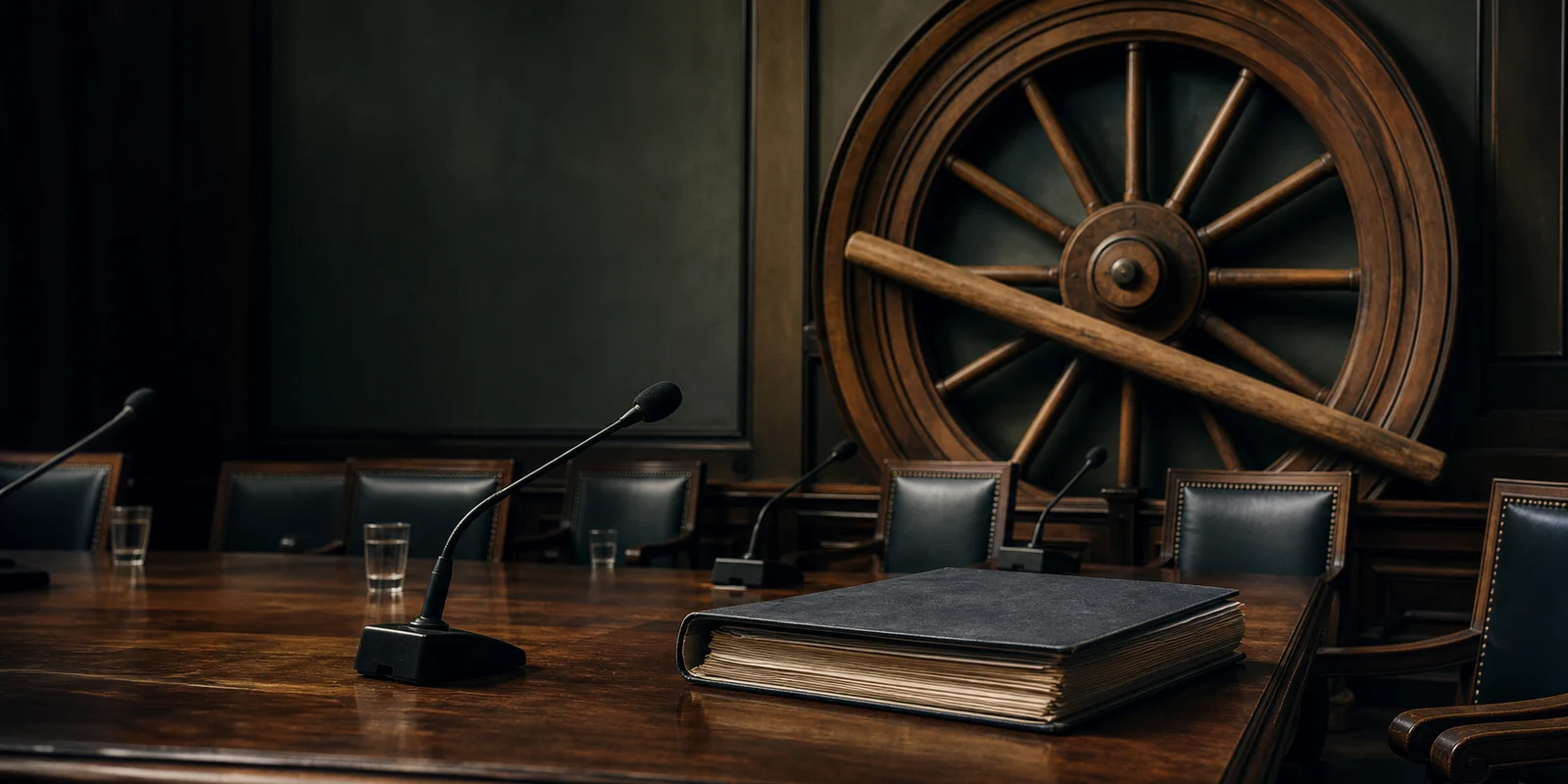
The metaphor already carries a verdict: if the government is the wheel, whoever does not go along becomes the obstacle.
The stick in the wheel is not just a jab. It is a way of arranging the scene.
First, it defines the government as movement. There is a wheel advancing: childhood, safety, people on the street, education, the interior. Then it defines the opposition as an external object interrupting that movement. Not as an adversary discussing priorities. Not as a parliamentary bloc managing its votes. Not as an actor that can be wrong, negotiate or demand changes. As a stick.
And nobody wants to be the stick.
That is the rhetorical efficiency. The metaphor does not need to explain much because it already contains a morality. The wheel is progress. The stick is damage. The wheel carries poor children. The stick leaves them waiting. The wheel protects neighbors. The stick blocks public safety. The wheel invests in the interior. The stick punishes.
The problem is that a budget bill is not a wheel.
It is a political decision.
It contains priorities, amounts, timing, sources, omissions, assumptions, distribution of costs, negotiable articles, defensible articles, weak articles, promises presented as certainties and beneficiaries used as arguments. Every budget comes with a list of desirable goods. No government sends a bill to Parliament saying: this project is here to make people’s lives worse.
So naming real beneficiaries is not enough to make the package undisputable.
It may be true that there are important resources for childhood. It may be true that there are defensible allocations for safety or education. It may be true that the opposition is moving too fast, closing itself off or trying to wear down the government before listening to the ministries. All of that may be true.
But none of it removes the political obligation to persuade.
A government that lacks the votes to approve its budget bill is not facing an anti-democratic accident. It is facing Parliament. It has to persuade, concede, order priorities, negotiate text, accept controls, separate the essential from the accessory and decide what cost it is willing to pay for each article.
Governing is not pushing a wheel while everyone else applauds.
Governing is securing enough legitimacy for the wheel to move.
The criticism of the opposition may be valid. Announcing a general no before listening to all agencies can be read as rigidity. It can also be a parliamentary strategy: mark a position, force negotiation, prevent the government from installing the idea that every social article is shielded by its beneficiary. We will have to see what the opposition does next, what it proposes, what it accepts, what it negotiates and what it explains.
But that discussion requires arguments.
The stick-in-the-wheel formula replaces them with a moral accusation.
It does not merely say: the opposition is wrong. It says something stronger: the opposition is harming those who need the most. It does not say: this refusal is irresponsible for these reasons. It says: if they do not go along, they punish the poor. It does not say: let us defend these articles and discuss the rest. It says: those who disagree are the obstacle.
That operation is tempting for any governing party.
Including this one.
Because when the government manages to present its project as the wheel of social justice, every brake looks like cruelty. The question about design becomes bad faith. The question about numbers becomes insufficient sensitivity. Negotiation becomes blackmail. Parliamentary oversight becomes obstruction.
And democracy becomes poorer.
Not because the opposition is automatically virtuous. It is not. It can act with calculation, opportunism, electoral anxiety, bad memory or a blocking reflex. It can say no before reading enough. It can enjoy the government’s discomfort too much. It can stay in tactics and fail to offer a serious alternative.
But even a mediocre opposition keeps a basic democratic function: forcing the government to explain better.
That function is not a courtesy.
It is part of the system.
The wheel of a republic is not designed to spin without brakes. It has brakes, counterweights, chambers, committees, appearances, majorities, minorities, press, archives, requests for information and citizens watching. Not every brake is sabotage. Sometimes the brake prevents abuse. Sometimes it prevents improvisation. Sometimes it only forces an article to be written better. Sometimes, yes, it can be irresponsible maneuvering. But that has to be shown, not decreed through a metaphor.
What is interesting is that Caggiani’s phrase does not appear alone.
It belongs to a climate.
When the Yamandú Orsi episode emerged, with the Primary Education tax debt and works or improvements not updated before Cadastre, the Frente Amplio found a similar defense, though in another register.3 The institutional question was sober: what standard of care should the president accept regarding obligations that the state itself demands from citizens? The amount was small, yes. The office was not.
But the discussion quickly moved toward the tone of the opposition. Leonardo Pereyra wrote in El Observador that the opposition chose fury before the balcony and that the Frente Amplio took advantage of that overacting.4 He had a point. An opposition that confuses firmness with fury hands the government a perfect excuse.
But the excuse does not answer the substance.
In the Orsi case, the official reflex was to present the question as a hunt, an operation or an obsession. In the budget bill, the reflex appears as “stick in the wheel.” They are not identical episodes. One concerns the personal and institutional responsibility of the president; the other concerns budget negotiation. But they share a grammar.
The one who asks exaggerates.
The one who controls obstructs.
The one who does not support punishes.
The one who disagrees does not argue: he blocks.
That grammar is comfortable for governing and poor for deliberating.
An adult democracy needs something else. It needs the governing party to defend its budget bill without turning every opposing vote into harm against the poor. It needs the opposition to reject, negotiate or condition without hiding behind empty slogans. It needs a president to explain a debt paid late without every question being treated as persecution. It needs the press to make power uncomfortable without always receiving the operation manual as an answer.
The key word is not “stick.”
It is “wheel.”
Who decides which wheel must turn? Who defines the direction as correct? Who is allowed to touch it? Who can ask that the axle be reviewed, that a piece be changed, that an article be removed, that a number be explained, that one allocation be separated from another? Since when does the government equal movement and disagreement equal obstruction?
That is the point.
Caggiani can criticize the opposition. He has the right and political reasons to do so. If he believes the general no is irresponsible, he should say it. If he believes urgent social allocations are being put at risk, he should defend them. If the government has solid articles, it should put them on the table and force the opposition to explain why it will not vote for them.
But democracy does not improve when the government replaces negotiation with a moral scene in which it drives the wheel and everyone else throws sticks at it.
The opposition should not make itself easy to caricature either. If it announces a no, it has to explain the no. It is not enough to invoke fiscal prudence, fatigue, distrust or strategy. It has to say which articles it rejects, which it would vote for, what changes it demands, what priorities it proposes and what cost it is willing to assume. If it does not, the government will have more room to present its refusal as pure obstruction.
That is the symmetrical demand.
The government cannot moralize every disagreement.
The opposition cannot turn every disagreement into an automatic gesture.
A republic works when yes and no both have to argue.
That is why Caggiani’s phrase deserves more attention than outrage. Not because it is exceptional, but because it shows a temptation of the time: turning democratic conflict into a scene of good and bad. On one side, those who want to move the wheel of good. On the other, those who jam it with a stick.
That scene works for a tweet.
It is not enough for governing.
Parliament is not there to applaud the wheel. It is there to ask where it is going, who is pushing it, who pays for the road, who rides above, who remains below and what happens if the axle is crooked.
Sometimes the opposition does put sticks in the wheel.
Sometimes the government calls a stick what it has not yet managed to turn into agreement.
The difference matters.
Footnotes
-
Teledoce, «“La Coalición del palo en la rueda”: legisladores del FA criticaron a la oposición por no votar la Rendición de Cuentas», July 9, 2026. ↩
-
Radio Carve, «Propiedades de Orsi figuran con deuda de Primaria y obras no actualizadas en Catastro», July 6, 2026. ↩
-
El Observador, «Orsi patina, la oposición elige la furia antes que el balcón y el Frente se aprovecha», July 9, 2026. ↩