
The machine does not fire anyone by itself
The jobs apocalypse has one enormous narrative advantage: it is easy to understand.
A machine enters.
A person leaves.
The boss looks at a screen, discovers that the same work can be done with fewer people, presses an invisible button and human labor is left behind as sentimental residue. The scene is brutal, simple, almost cinematic. It is also too convenient.
If the disaster arrived like that, with smoke, alarms and millions of simultaneous layoffs, everyone would recognize it. No theory would be needed. One would only have to look at the line outside the door.
But history rarely works with such neatness.
The degradation of work can arrive without a single scene. It can appear as a task that used to be done by a person and is now reviewed in a hurry. As one meeting less. As one metric more. As an automatic answer the employee must correct, without that correction being counted as new work. As a promise of productivity that does not reduce the working day, does not raise wages and does not return time. As retraining paid for by the worker. As a company calling “efficiency” what used to be called transferring risk.
The apocalypse, when it becomes too large an image, can keep us from seeing smaller, more distributed and more likely forms of damage.

AI does not enter work like a meteorite. It enters as system, contract, dashboard, provider and managerial decision.
The wrong question
The wrong question is: will AI destroy all jobs?
It is wrong not because it is absurd, but because it turns a social process into a scene of extermination or salvation. If the answer is yes, all that remains is waiting for the blow. If the answer is no, many feel the problem has disappeared.
Between those two answers there is an entire country.
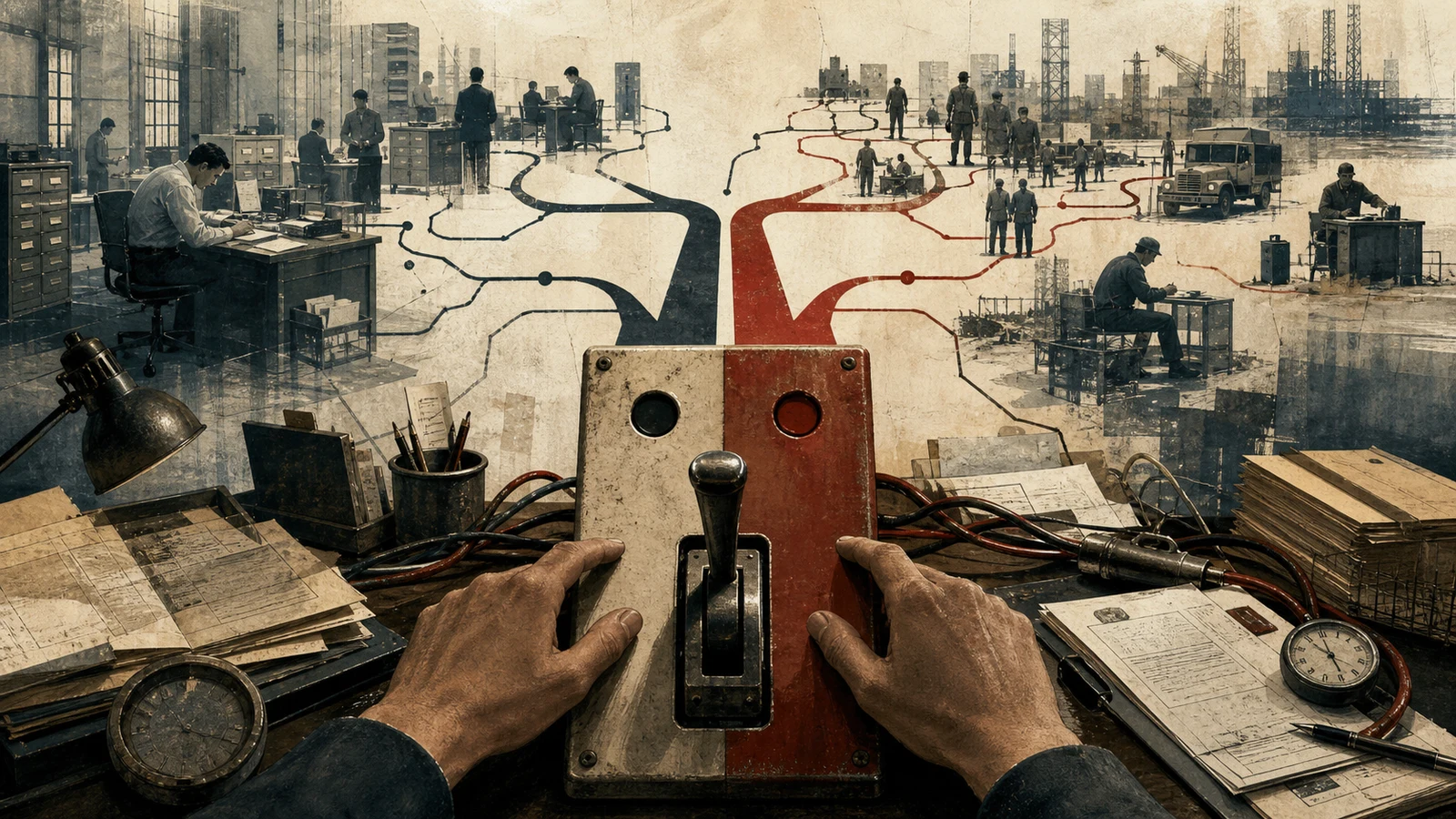
The binary question reassures because it organizes. The real problem begins when work opens into more than two paths.
The better question is this: if AI allows more to be produced, faster, with less human intervention, who keeps that gain?
The worker, in the form of fewer hours, better pay, paid training and more autonomy?
The State, in the form of more revenue, better public services, funded social security and technical capacity of its own?
Society, in the form of liberated time, better distributed care, stronger education and fairer access?
Or capital, in the form of margin, valuation, dividends, market power and the ability to impose the next condition?
That is where the subject changes. We are no longer asking whether the machine “takes” work as if it stole a bicycle. We are asking how new productivity is distributed when it appears inside old relations of power.
The machine does not fire anyone by itself.
Someone buys the machine.
Someone redesigns the job.
Someone decides that the efficiency gain will not become a shorter working day.
Someone calls a person a “collaborator” while software makes that person more subordinate.
Someone explains that wages cannot rise yet because the market is uncertain.
Someone converts a technical innovation into a labor decision.
And later, if possible, blames technology.
The calm of economists
The Economist article has one important virtue: it cools the scene.1
It recalls that economists usually distrust the idea that there is a fixed amount of work and that machines simply come to take a share of it. That idea, often called the lump of labor fallacy, imagines the labor market as a still cake. If technology takes one slice, the human loses that same slice.
History is stranger than that.
David Autor made the point in a classic way: automation replaces tasks, not simply entire jobs, and it can also increase demand for complementary human tasks.2
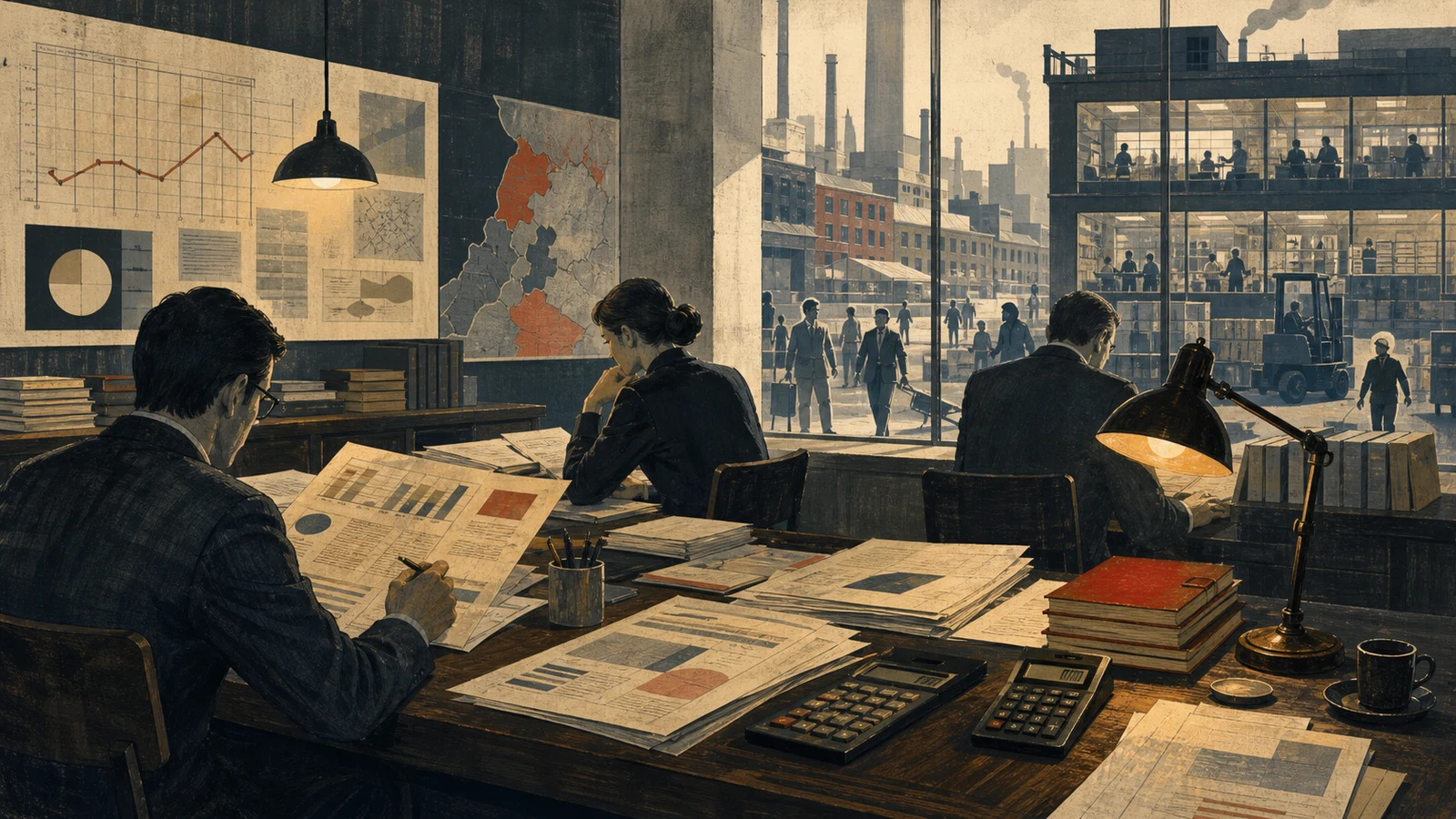
Cooling the scene does not mean denying conflict. It means looking at evidence before buying an epic.
A technology can destroy occupations, but it can also make goods cheaper, open sectors, move income, create needs, reorganize firms, free resources and produce jobs that did not exist before. Agriculture did not disappear in an afternoon when new tools arrived. The tractor did not expel whole generations in a single day. Computing did not eliminate office work at once. Containerization destroyed certain port trades, but it also reorganized commerce, logistics, scale and consumption.
None of that makes technology innocent.
It only makes the image of direct replacement too poor.
The article also reminds us of a fact that bothers catastrophism: the labor market in rich countries is not, for now, broken by AI. When the OECD devoted its Employment Outlook 2023 to artificial intelligence, it framed the matter through occupational exposure, adoption, job quality and institutional bargaining, not as the universal and immediate disappearance of work.3 The United States still projects net employment growth for 2024-2034, according to the Bureau of Labor Statistics.4
That does not prove that nothing will happen.
It proves something more modest: we are not yet seeing, in broad labor data, a wave of mass unemployment caused by AI.
The difference matters.
Not seeing a phenomenon yet is not the same as proving it impossible.
But repeating “apocalypse” is not enough to skip the evidence.
Slow history
The most useful part of The Economist’s text is historical.
If AI produces massive, fast and persistent unemployment, it will not be replaying a familiar movie. It will be opening a new scene.
Robert Gordon, the Northwestern economist, has spent years working on the limits of growth at the technological frontier. In a 2012 paper, he looked at per-capita GDP growth in the leading economy of each period and argued that the historical frontier had not exceeded certain sustained rhythms of expansion.5
The point is not to turn Gordon into an oracle.
The point is simpler: for centuries, even enormous technologies took time to diffuse.
The steam engine did not appear and transform the whole economy the next morning. The tractor did not enter every field at once. Electricity needed networks, adapted factories, motors, investment, habits, regulation, infrastructure. The computer did not become visible productivity the minute it reached the desk. Each technology had to pass through institutions, costs, learning, resistance, contracts, organizational culture, infrastructure and concrete uses.
The history of technology is not only the history of inventions.
It is the history of adoption.
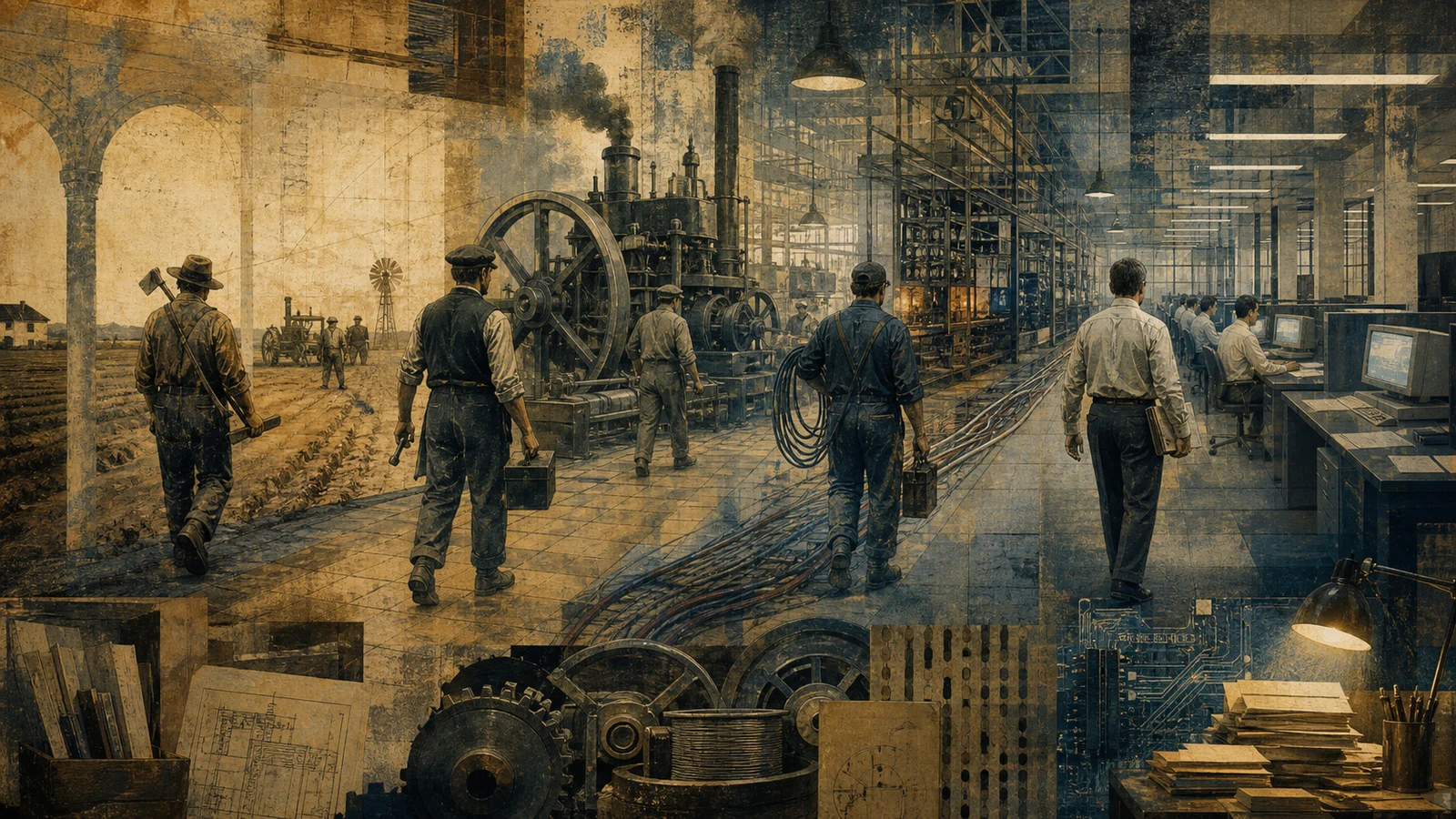
Technologies do not change the world when they appear. They change it when they pass through institutions, costs, habits and forms of work.
And adoption is social.
That is why the question of AI cannot remain inside the benchmark of the newest model. A model can improve brutally, but work does not live inside a benchmark. It lives in companies, ministries, courts, classrooms, hospitals, accounting firms, newsrooms, call centers, cooperatives, banks, workshops, law offices, shops and platforms.
There, technology does not enter as a pure idea.
It enters as contract, training, resistance, fashion, consulting, public procurement, managerial pressure, promised savings, union fear, PowerPoint presentation, badly integrated software, foreign provider, boardroom enthusiasm and employee fatigue.
That mediation can slow change down.
It can also make it more opaque.
Engels is not enough
Silicon Valley has a strange relationship with the Industrial Revolution.
It invokes it when inevitability is useful. It uses it to say: yes, there was pain, but later came more wealth. Or it uses the opposite warning: perhaps we will live through another long pause of stagnant wages while the owners of the new machine take everything.
The Economist revisits that comparison and lowers the volume.
The so-called Engels’ pause, the period in which British real wages may have stagnated while the Industrial Revolution enriched capitalists, does not work cleanly as a template for AI. There was slow wage growth, yes. There were miserable conditions, too. But labor history was not a simple wave of technological unemployment. British employment grew substantially during the nineteenth century. The composition of work changed less abruptly than is often imagined. And a central part of the damage to workers came from cost of living, food, wars and grain tariffs.
The useful sentence is not that machines were innocent.
The useful sentence is this: very often, the villains are less inside the machine than inside the politics that organizes its effects.

The machine can stand at the center of the scene and still not explain the damage by itself.
That helps more.
It lets us leave behind an infantile discussion.
AI will not be good because it is technology. It will not be bad because it is a machine. It will be socially good or bad according to the regime that incorporates it: ownership, regulation, bargaining, education, taxation, working hours, wages, transparency, audit, social security, institutional culture.
The question is not whether the machine has intentions.
The question is who has power when the machine enters.
Here an old word from Lukács helps, if used carefully: reification. A social relation appears as a thing. A decision by a company, a State or a platform presents itself as technical necessity. The system says: “the tool requires it.” The essay has to answer: someone requires it.6
Damage without apocalypse
There is a kind of calm worth disputing.
It says: if there is no mass unemployment, there is no serious problem.
No.
There may be no mass unemployment and still be a hard transformation of work.
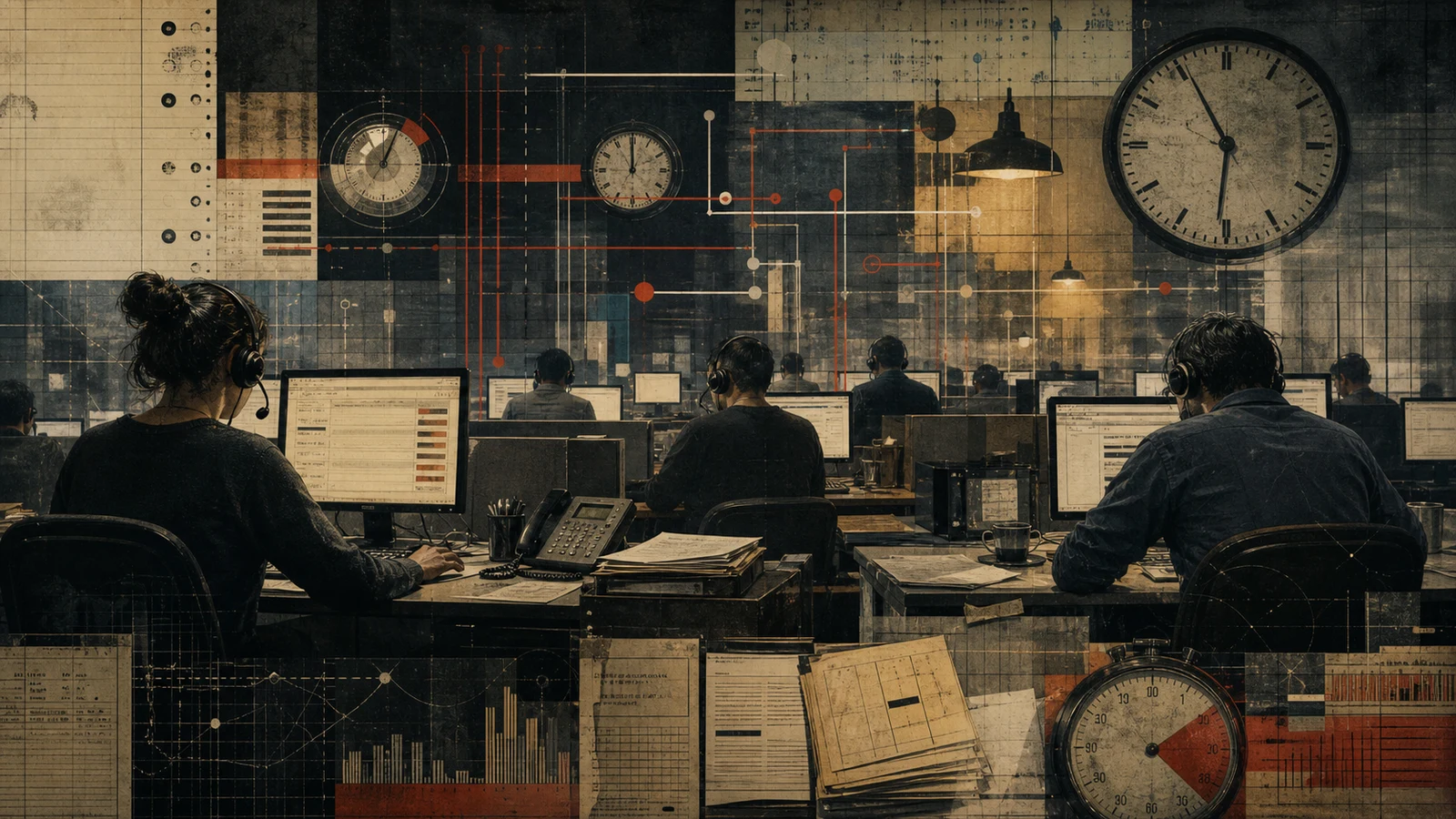
A job can survive and become poorer, more watched, more intense or less explainable.
The most probable labor damage will not always look like unemployment. Sometimes it will look like survival.
A worker keeps the job but loses authority over the task. A professional keeps the title but becomes a validator of machine output. A teacher keeps teaching but spends more time feeding platforms than speaking with students. A journalist keeps writing but now must produce more, faster, with fewer colleagues. A designer keeps designing but the first thirty options arrive from a system that also trains clients to expect endless variation.
This is not the end of work. It is work made thinner.
There are forms of dispossession that do not require dismissal. The worker remains, but a part of the craft is extracted. The pace is reorganized. The standard rises. The time saved by the machine does not return to the person who must use it. It is immediately reinvested as pressure.
That is why the calm language of productivity can be so dangerous. Productivity for whom? Under what agreement? With what redistribution? If the same number of people produces twice as much and nothing changes in wages, time, autonomy or social protection, then productivity has not liberated work. It has made extraction more elegant.
The debate should not begin with the robot replacing the human.
It should begin with the spreadsheet that silently changes what the human is expected to be.
The ILO warned in 2023 that generative AI would likely augment or transform more jobs than it would fully replace, while also noting that the main impact may fall on job quality, differential exposure and the distribution of tasks.7
That nuance is decisive.
A job can survive and lose autonomy.
It can survive and become more intense.
It can survive and be monitored by systems that measure speed, tone, pauses, productivity, response, ranking, error and availability.
Recent work on algorithmic management has been describing precisely that shift: not only automating tasks, but organizing, assigning, monitoring, supervising and evaluating labor through systems that are often opaque to the people subjected to them.8
It can survive and degrade into an anxious chain of reviewing machine output.
It can survive and require permanent upskilling without anyone paying for the learning time.
It can survive and pay worse because the company decides the hard part is now done by the system.
Unemployment is a brutal form of damage.
It is not the only one.
The worker may not be expelled from the factory. The worker may be converted into an accessory of a factory they no longer understand. The worker may not lose the position. They may lose control over rhythm, criteria and the explanation of what they do.
The question moves from quantity to quality.
Not only how many jobs remain.
What kind of job remains.
Productivity for whom
The Economist proposes a useful signal for detecting a strong disruption: rising productivity, weak real wages, growing corporate profits and job losses spread across several sectors.
That combination should be pinned to the wall of any serious discussion about AI.
Because it separates theatrical alarm from material alarm.
If productivity rises sharply and wages do not follow, someone is keeping the difference.
If companies produce more with less and the working day does not shrink, someone has converted technical efficiency into the appropriation of time.
If the worker must learn new tools outside working hours to remain employable, retraining is not public policy. It is private debt.
If the State buys systems it does not understand, it is not modernizing. It is outsourcing intelligence.
If a company uses AI to provide worse service faster while making responsibility harder to identify, it has not innovated. It has automated contempt.
For that reason, the discussion about productivity cannot be left in the hands of those who capture it.
A democratic policy of AI should contain one simple clause:
if a technology significantly increases productivity, society has the right to discuss where that gain goes.
Fewer hours.
Better wages.
Paid training.
Protected transitions.
Social security.
Audit.
Right to explanation.
Collective bargaining.
Public capacity.
There is no natural law saying that every efficiency must first become corporate margin.
That is not technology.
It is distributive politics in technical language.
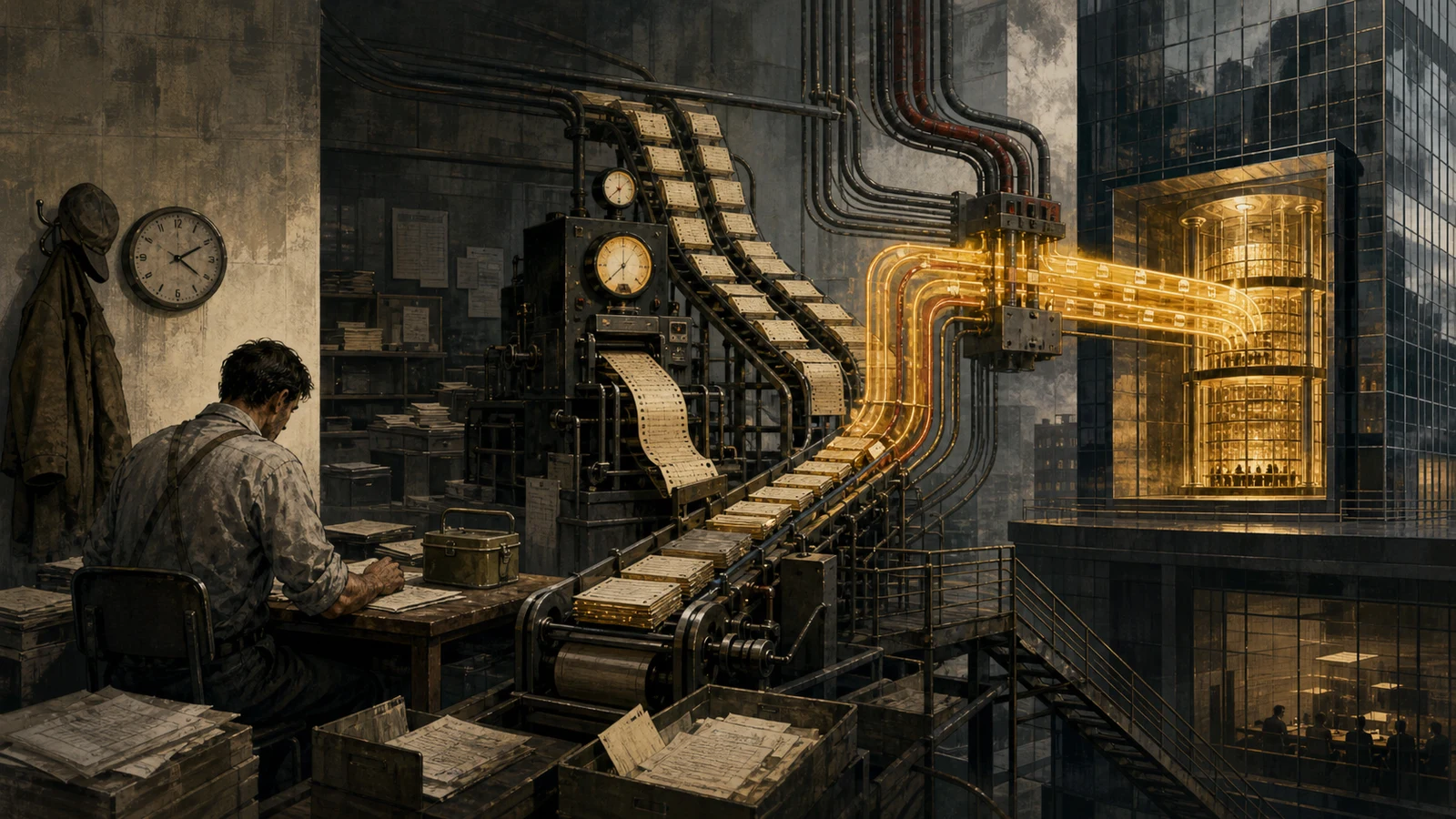
If productivity rises and life does not improve, someone is keeping the difference.
Recession as radiography
There is another uncomfortable point in the article: if AI’s labor disruption arrives, it will probably become clearer in a recession.
That makes sense.
Companies do not always reorganize everything when the economy is growing. They can absorb inefficiencies, preserve positions, test tools and postpone decisions. But when a downturn arrives, the language changes. What used to be an experiment becomes necessity. What used to be a pilot becomes adjustment. What used to be a complement becomes possible substitution.
Recessions work like cruel radiographs.
They show which tasks were considered expendable.
They show which companies had the power to transfer costs.
They show which workers had no defense.
They show which unions arrived late.
They show which States bought narratives instead of capacities.
They show which professions confused prestige with protection.
That is why it is not enough to watch the labor market only when everything seems relatively stable. The architecture has to be examined before the blow.
What tasks are being partially automated?
What new positions are born as machine supervision?
Which areas become more exposed?
Which skills become mandatory without wage recognition?
Which companies use AI to improve work, and which use it to reduce responsibility?
Which public agencies buy opaque systems?
What data is handed over?
Which providers remain inside?
What capacity remains in the country when the contract ends?
Waiting for the recession to discuss this means arriving when the machine no longer appears as tool, but as excuse.
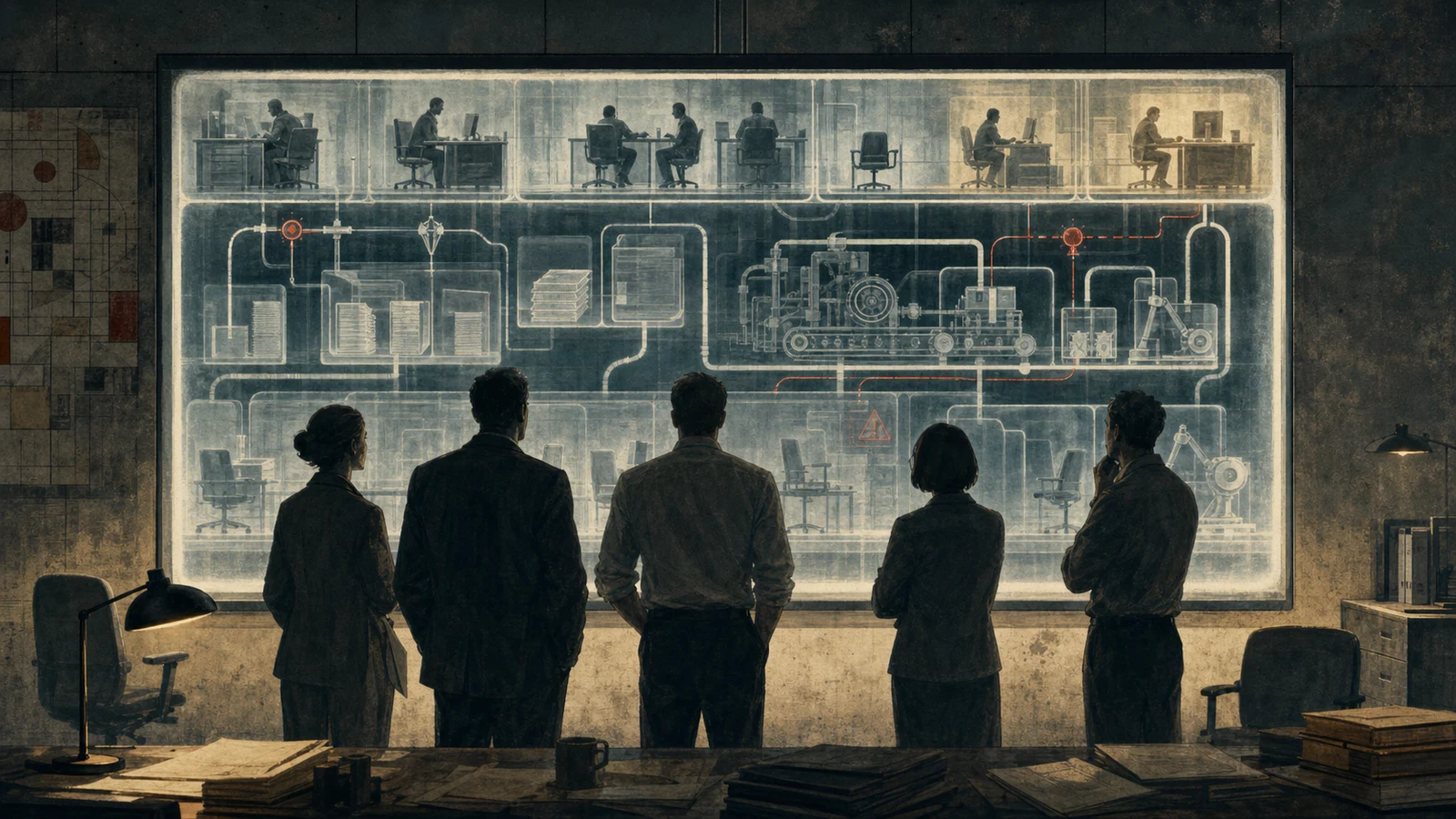
Recessions do not invent every decision. Often they reveal the architecture that was already prepared.
What Uruguay cannot watch from outside
Uruguay tends to look at these discussions as if they were happening far away.
Silicon Valley exaggerates.
Europe regulates.
The United States fires.
China scales.
Argentina fantasizes about non-human corporations.
And we comment.
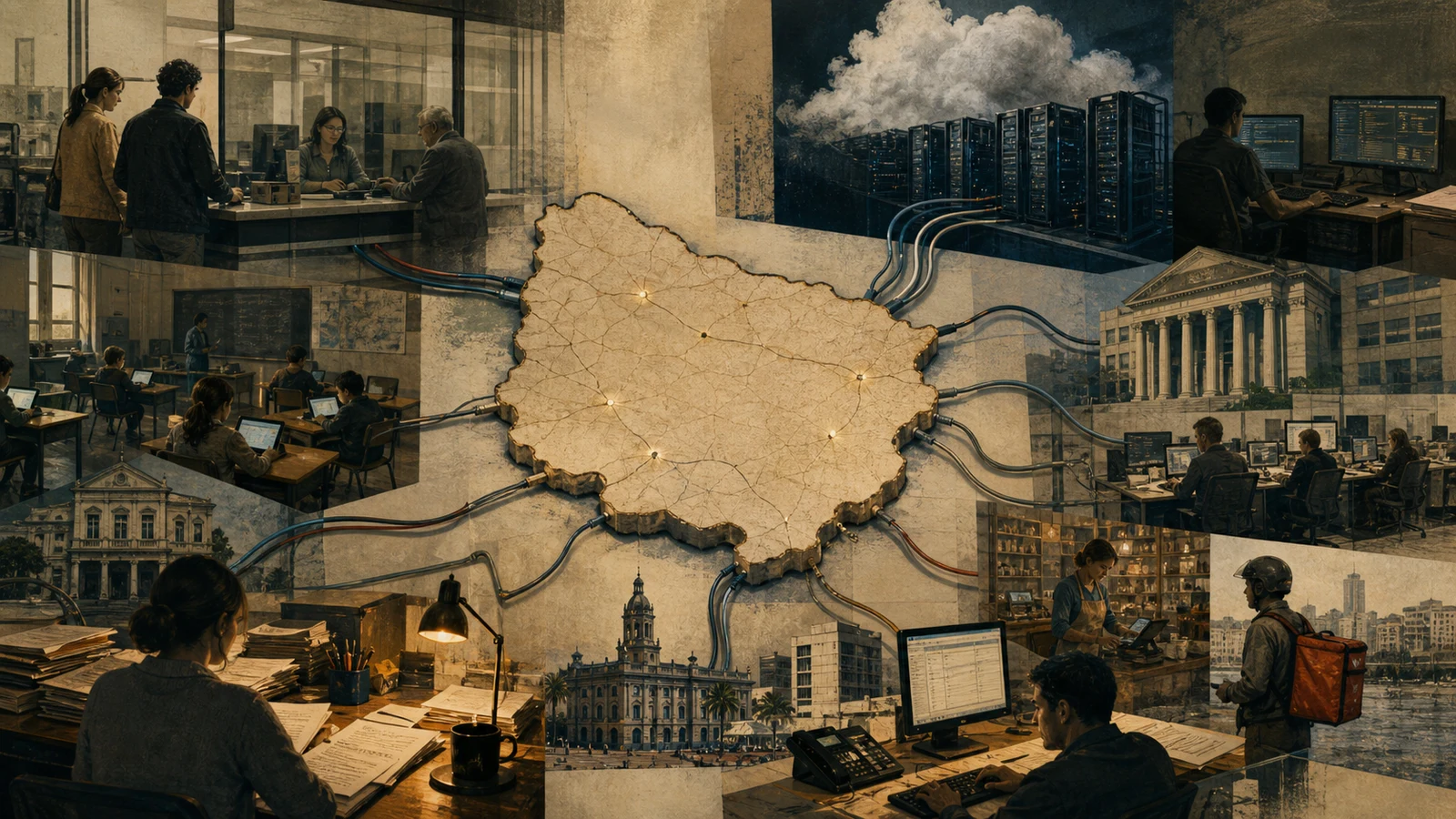
Uruguay is not watching a foreign revolution from the stands. It buys it, uses it, outsources it, teaches it, suffers it and normalizes it.
AI enters Uruguay through banks, call centers, public administration, education, media, software firms, legal services, design, logistics, accounting, health, agriculture and commerce. It enters through imported platforms, cloud contracts, consultants, dashboards and productivity promises. It enters through the small business owner who cannot hire another person but can pay for software. It enters through the public office that wants to answer faster. It enters through the student who submits a text without having gone through the difficulty of writing.
It enters through small tools nobody declares as revolution.
Uruguay already has a 2024-2030 national artificial intelligence strategy and a specific earlier strategy for digital government. That makes the discussion concrete: the question is not whether AI will reach the State and the local economy, but through what capacities, controls, responsibilities and sovereignty criteria it will be incorporated.9
At this point, even Mises, from a tradition far from this essay’s own, forces us not to simplify: lacking capital also produces subordination. Capital is not only money accumulated by others. It is also machinery, infrastructure, training, time, data, energy, organization and investment capacity. A country without its own technical capital does not govern AI by decree. It rents it, pays for it through licenses, accepts it in contracts and later calls one more dependency modernization.10
AI enters through the provider that adds a feature.
Through the boss who asks the same team to do more.
Through the ministry that buys a closed solution.
Through the university that discusses too late.
Through the company that begins measuring tasks it used to trust.
Through the independent worker who must compete against prices calculated on someone else’s automation.
Through the student who learns to deliver answers before learning to think questions.
Through the State that wants efficiency but does not develop technical muscle of its own.
It has already entered.
The local question is not whether Uruguay will create the next frontier model.
The question is whether it will have the public intelligence needed to negotiate the models it uses.
That means labor policy, education, data governance, public procurement, union knowledge, professional ethics and technical capacity inside the State. It means asking, before adoption becomes habit: what work is being replaced, what work is being hidden, what work is being intensified, what training is real, what savings are redistributed, what risks are externalized and what rights are updated before the adjustment arrives.
There is a continuity here with Batlle y Ordóñez against the algorithm: if a technology touches work, data, public services and economic power, it cannot be left only to private enthusiasm. There is also a continuity with The tool does not sign: the adult discussion is not solved by asking whether there was a tool, but who answers for what was done with it.
Rights before the adjustment
We do not need to know exactly how many jobs will disappear in order to think about rights.
In fact, waiting for total precision can become a way of doing nothing.
Nobody knows the final map yet. Not the executives selling the future, not the economists studying historical series, not the politicians who discover the topic when the word is already giving conferences, not the gurus who alternate between euphoria and fire depending on the audience.
But we do not need to know the ending to define principles.
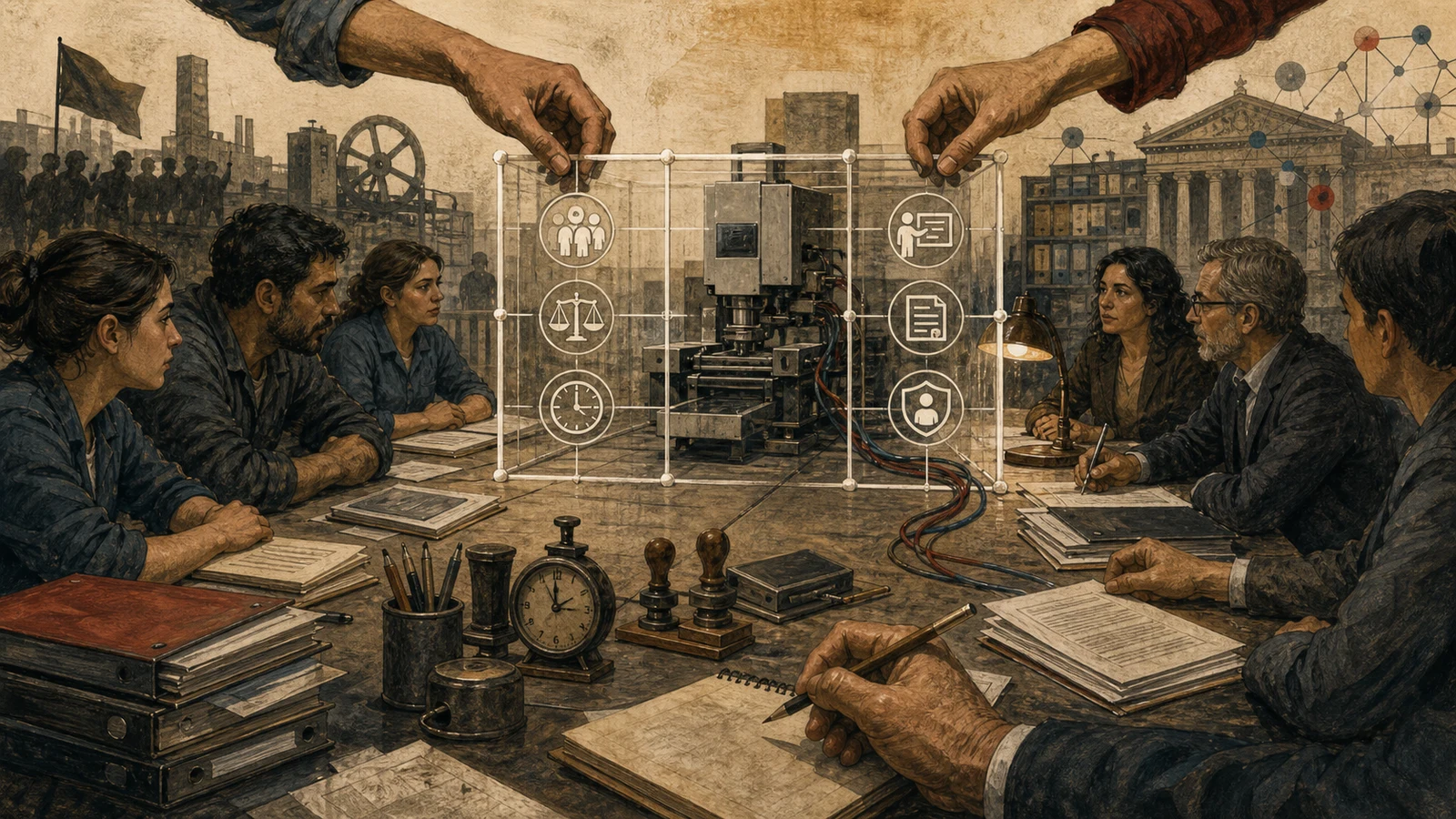
Rights should not arrive as an ambulance after the adjustment. They have to be on the table before reorganization becomes inevitable.
First: the right to know when a labor decision has been made, conditioned or evaluated by an automated system.
Second: the right to explanation when an algorithm affects hiring, evaluation, wages, continuity, access to shifts, ranking or workload.
Third: audit of systems used in sensitive areas, including the State, education, health, credit, employment and security.
Fourth: paid training when a company introduces tools that substantially change the task. If updating is mandatory to keep the job, it cannot be a night hobby.
Fifth: collective bargaining over productivity. If AI allows more to be produced, workers must discuss hours, wages, staffing, rhythms, rest and the distribution of benefits.
Sixth: protection against false autonomy. A platform does not stop organizing work because it calls the worker independent.
Seventh: a public registry of high-impact systems used by the State. No administration should affect rights through black boxes bought as if they were printers.
Eighth: exit clauses, portability and knowledge transfer in public procurement. A State that buys AI without learning anything buys dependency.
Ninth: taxes and social security designed for an economy where part of productivity may move from human labor to automated capital.
Tenth: an education policy that does not reduce the answer to prompt courses. Learning to use a tool is not enough. We have to understand data, bias, language, institutions, ethics, history, power and judgment.
None of this requires imagining a ministry of the future with a trade-show aesthetic.
It requires something more sober: not letting the adjustment happen first and rights arrive later as a first-aid manual.
The fantasy of clean replacement
Business imagination loves clean replacement.
One task leaves.
One tool enters.
The cost falls.
The client notices nothing.
The world continues.
But real work is full of sticky zones. People who know where the file is even though the system does not. Administrative workers who understand exceptions. Teachers who read a face before continuing. Nurses who detect something strange in a tone. Booksellers who recommend a book they do not have. Journalists who know when a sentence is too polished to be true. Programmers who distrust an elegant solution because they remember the previous disaster. Public workers who remember why a rule exists even when the system treats it as an obstacle.
AI can assist many of those tasks.
It can accelerate parts.
It can organize.
It can summarize.
It can suggest.
It can compare.
It can find patterns.
It can even do some things better than we did them through fatigue, hurry or habit.
But when an organization confuses the automatable part with the whole job, damage begins.
Because craft does not always appear as a task line.
Judgment is not always measured.
Responsibility does not always produce a file.
Trust does not always enter a dashboard.
Experience often works by preventing errors that never happen and therefore never get counted as value.
Hayek helps here for a precise reason: a decisive part of social knowledge is dispersed, attached to concrete circumstances, trades and practices no center can fully see. The algorithmic fantasy of clean replacement consists of believing that, because one part of work has been turned into data, all of that knowledge has already been captured.11
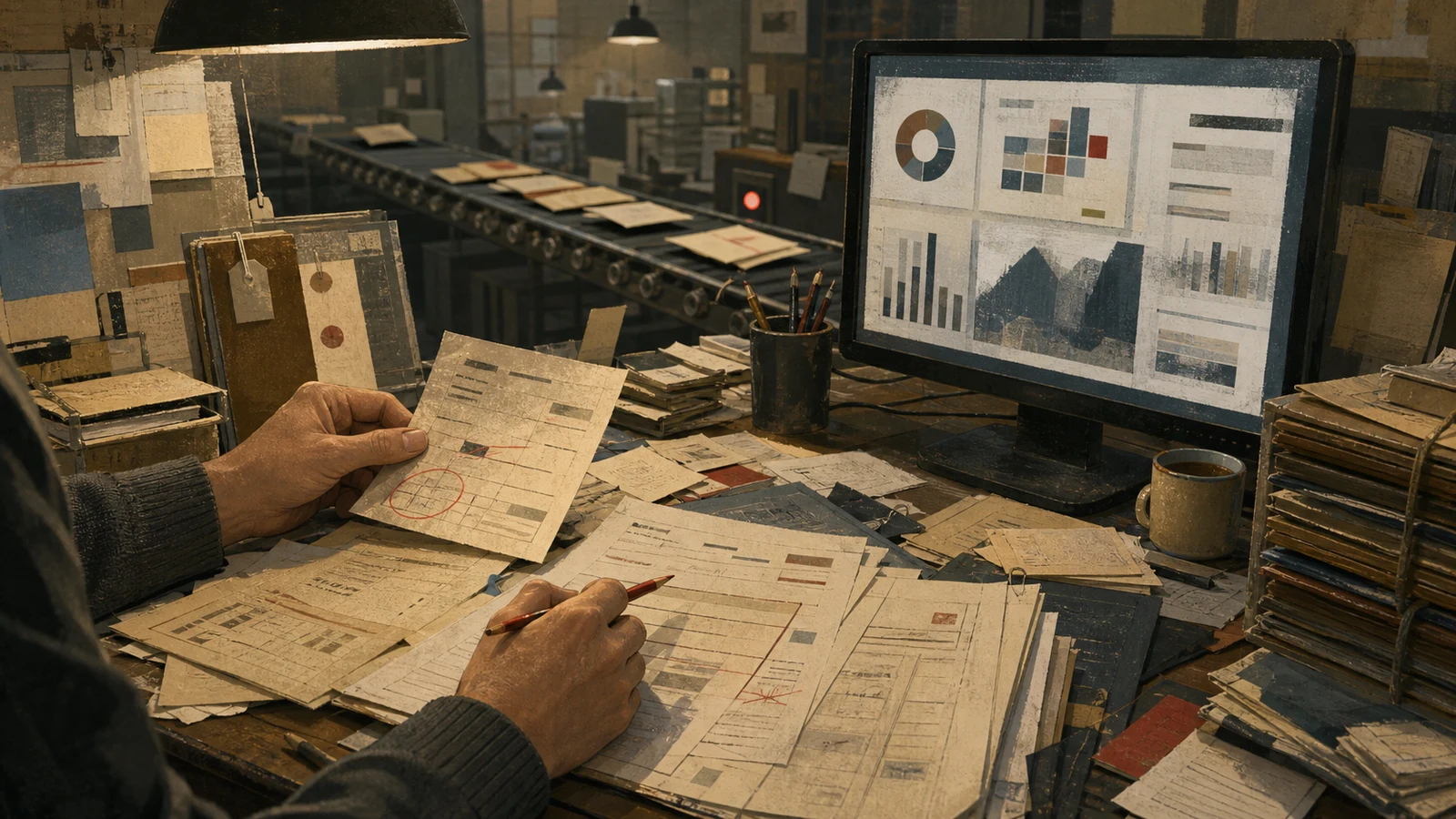
The dashboard measures what is visible. Craft often works exactly where the dashboard does not reach.
The machine can imitate the visible part.
The company can decide that this is enough.
The problem begins in that decision.
Saving jobs is not enough
A defensive labor policy can fall short if its only slogan is preserving positions.
Some jobs should not be preserved exactly as they are.

Defending work is not defending every task. It is defending income, time, craft, autonomy and dignity.
There are repetitive, unhealthy, absurd, humiliating, needlessly slow or bureaucratic tasks that a technology can reduce. It would be ridiculous to defend suffering just to prove humanity. No sensible person should romanticize the useless form, the repeated call, the double entry, the meaningless spreadsheet, the procedure that forces a person to act as a bridge between systems that do not speak to each other.
The defense of work cannot be the defense of every form of work.
It has to defend dignity, income, time, craft, autonomy, safety, learning and participation in the decisions that reorganize common life.
If AI eliminates miserable tasks and returns time, welcome.
If it eliminates miserable tasks and creates miserable surveillance, we have not advanced much.
If it increases productivity and shortens the working day, there is social progress.
If it increases productivity and increases pressure, there is capture.
If it helps the worker do better work, there is a tool.
If it is used to make the worker responsible for a chain they do not control, there is a trap.
If it lets the State serve better, explain more clearly and resolve more fairly, there is modernization.
If it lets decisions hide behind an interface, there is cheap technocracy.
The difference is not in the model.
It is in the institution that incorporates it.
The signals
So what should we watch?
Not only announcements of layoffs.
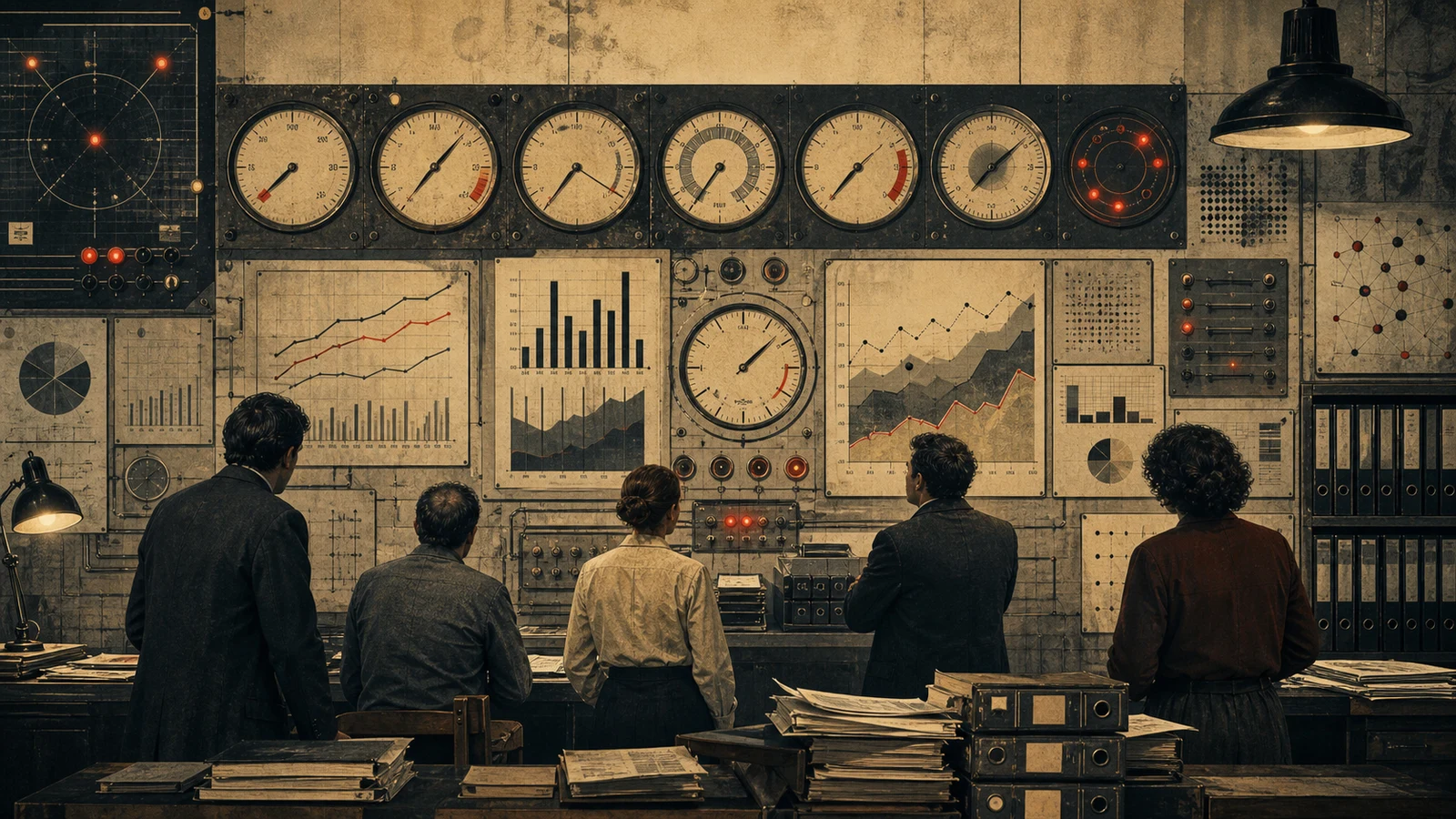
Labor damage does not always appear as news. Sometimes it appears as indicator, intensity, dependency or statistical silence.
Also sectoral productivity.
Real wages.
Labor share of income.
Corporate profits.
Hours worked.
Work intensity.
Medical leave.
Turnover.
Subcontracting.
Platformization.
Monitoring.
Automated evaluations.
Unpaid training.
Public procurement of opaque software.
Provider concentration.
Cloud dependency.
Quality of service.
The right to challenge automated decisions.
We do not need to wait for a fallen statue to know that a city has changed.
Sometimes it is enough to watch who can walk calmly and who must ask permission from a system they do not understand.
The machine does not sign
In another essay I wrote that the tool does not sign.
Here we should add something similar: the machine does not fire anyone by itself.
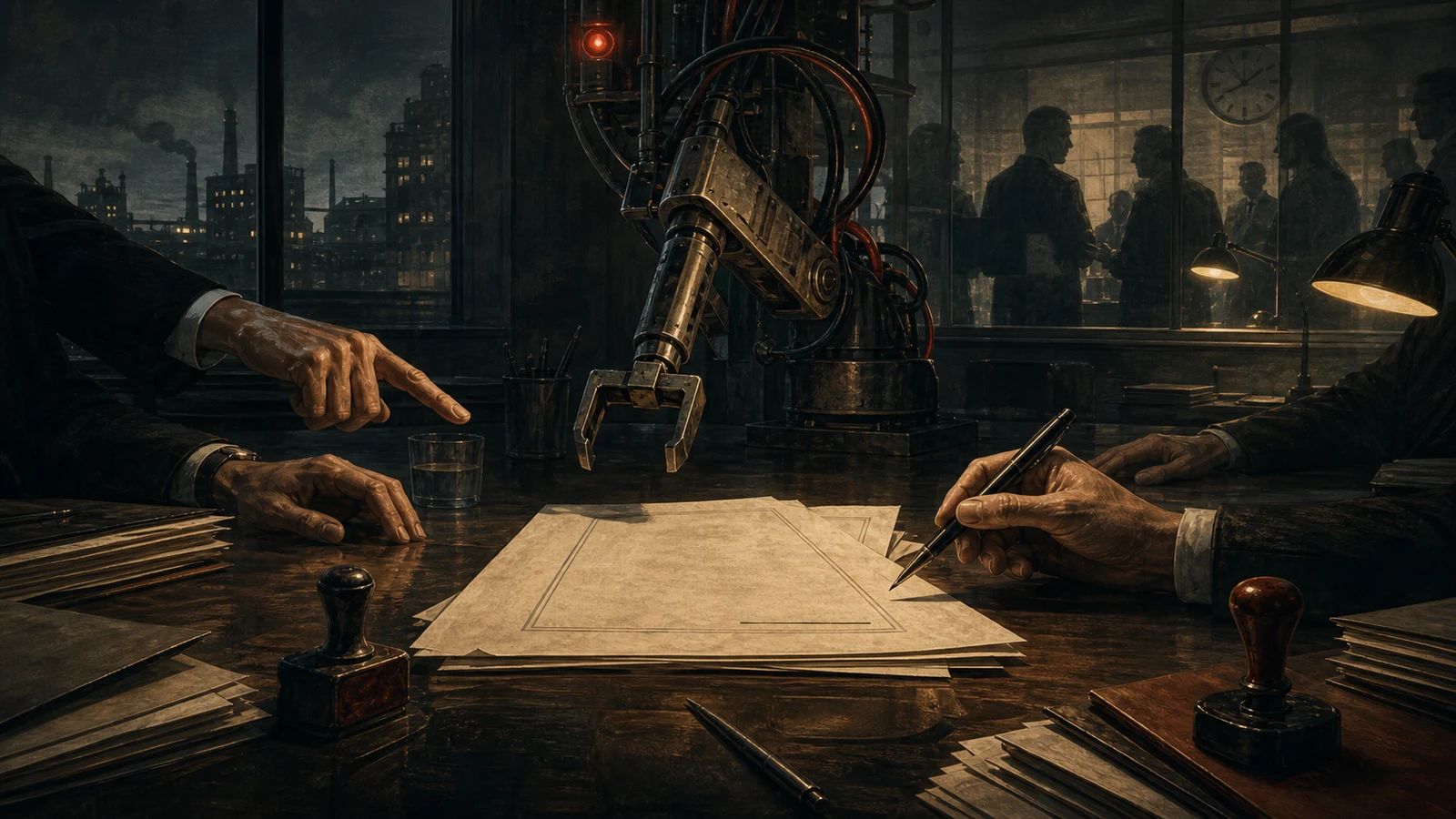
The machine can execute. The decision still has an owner, an institution, a contract and a signature.
There is a childish way to blame the machine.
As if the machine were a sovereign actor. As if an algorithm woke up one morning and decided to lower wages. As if a model could sign a labor reform, close a department, outsource a task or turn a worker into a contractor.
The machine does not sign.
That is why the political problem is not only technological. It is institutional. We need to know who decides, who benefits, who pays and who can contest the decision. We need to stop treating AI as weather and start treating it as organized power.
The machine does not decide that productivity should go only to profits.
The machine does not decide that a person should work faster for the same wage.
The machine does not decide that retraining should be an individual problem.
The machine does not decide that the State should buy black boxes.
The machine does not decide that a worker should be unable to appeal.
The machine does not decide that efficiency is worth more than dignity.
All of that is decided by people, companies, governments, institutions, contracts, laws, managerial cultures and correlations of force.
That is why the labor apocalypse, if it arrives, will not come only from artificial intelligence.
It will come from a political intelligence too poor to distribute its benefits, too slow to regulate its harms, too fascinated by efficiency to ask about life, too comfortable to distinguish innovation from abuse.
Perhaps AI will not produce an endless line of unemployed people.
Perhaps there will be no single scene.
Perhaps history will again be slower, more mixed, harder to narrate.
But if in a few years we produce more, work worse, earn the same, understand less, depend more and call a silent transfer of power progress, we will not be able to say nobody saw it coming.
It will not have been the machine alone.
It will have been a society that confused productivity with destiny.
Martín Álvarez (@unfalsoguru)
Working references
Footnotes
-
The Economist, “The jobs apocalypse: a (very) short history”, May 14, 2026. ↩
-
David H. Autor, “Why Are There Still So Many Jobs? The History and Future of Workplace Automation”, Journal of Economic Perspectives, volume 29, number 3, 2015. ↩
-
OECD, “OECD Employment Outlook 2023: Artificial Intelligence and the Labour Market”, OECD Publishing, Paris, 2023. ↩
-
U.S. Bureau of Labor Statistics, “Employment Projections: 2024-2034 Summary”, August 28, 2025. ↩
-
Robert J. Gordon, “Is U.S. Economic Growth Over? Faltering Innovation Confronts the Six Headwinds”, NBER Working Paper 18315, August 2012. ↩
-
György Lukács, “Reification and the Consciousness of the Proletariat”, in History and Class Consciousness, 1923. ↩
-
International Labour Organization, “Generative AI likely to augment rather than destroy jobs”, August 21, 2023. See also the related working paper on quantity and quality of employment. ↩
-
International Labour Organization, “Algorithmic management in the workplace”, ILO topic page on systems that organize, assign, monitor, supervise and evaluate work. See also ILO/JRC, “Algorithmic Management practices in regular workplaces: case studies in logistics and healthcare”, February 19, 2024. ↩
-
Agesic, “Estrategia Nacional de Inteligencia Artificial del Uruguay 2024-2030”, November 19, 2024; and “Estrategia de Inteligencia Artificial para el Gobierno Digital”, 2020. ↩
-
Ludwig von Mises, “Economic Policy: Thoughts for Today and Tomorrow”, lectures delivered in Buenos Aires in 1959. ↩
-
Friedrich A. Hayek, “The Use of Knowledge in Society”, American Economic Review, volume 35, number 4, September 1945. ↩