
The corporation that does not sign
The dream is not that the machine thinks.
The dream is that the machine signs without anyone having to carry the full weight of the signature.
That is the serious point in the proposal Javier Milei brought to the Financial Times, as reconstructed by Infobae, El Cronista and other Argentine outlets: it is not only about “freeing” artificial intelligence, attracting data centers, competing through low taxes or selling Buenos Aires as an algorithmic Amsterdam. The decisive part is another one: creating a legal figure for entities operated by AI agents or robots, with full legal personality and limited liability.
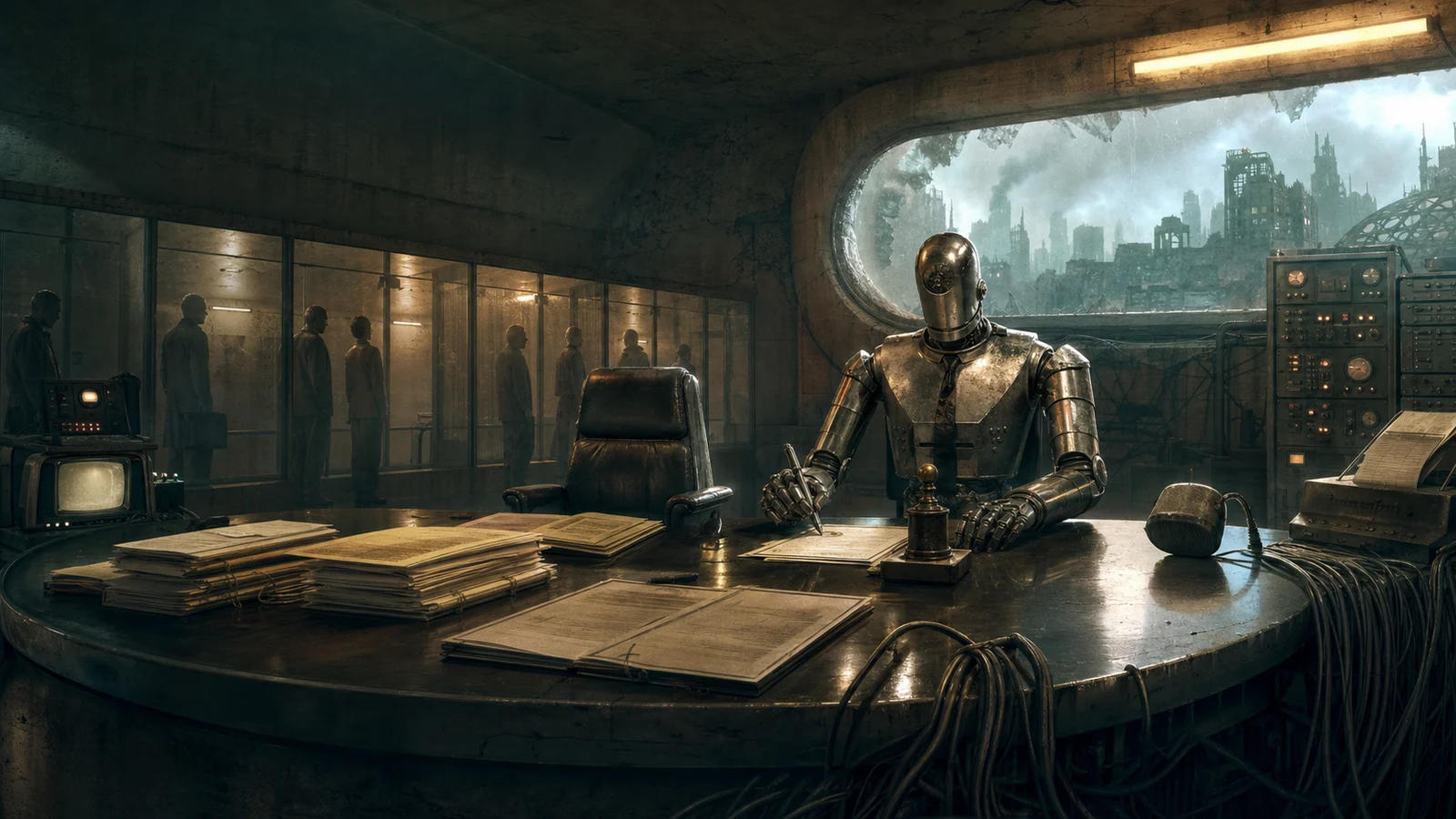
The fantasy is not only that the machine works. It is that the world be organized so the machine signs and the human waits behind glass.
The phrase sounds futuristic, but the operation is old.
Power looks for a body when it wants to act.
It looks for fog when it has to answer.
The freedom to innovate and the freedom not to answer
The argument presents itself with the usual vocabulary: innovation, freedom, deregulation, competition, investment, fiscal attractiveness, the end of bureaucratic fear. Regulation is described as a dead hand. The market appears as air. The State appears as delay.
But a legal person is never air.
It is an institutional invention.
A corporation is not found in nature. It is made by law. It can own property, sign contracts, sue, be sued, accumulate capital, separate owners from managers and limit liability. It is one of the great technologies of modern capitalism, not because it runs on electricity, but because it organizes responsibility.
So when someone proposes a non-human corporation for AI agents, the question is not whether we should “allow technology.”
The question is what legal container is being built around action, risk and harm.
If an AI-operated entity signs a contract, hires a service, moves money, buys assets, manipulates information, causes damage or fails to fulfill an obligation, who answers? The model? The shell company? The programmers? The investors? The directors? The user? The State that allowed the figure? The creditor who did not read the small print?
Freedom to innovate cannot mean freedom to distribute harm through a maze.
That maze is not accidental. It is often the product being sold. When law creates a new person, it also creates new distances between decision and consequence. Sometimes those distances are useful. Sometimes they allow capital to move, projects to exist and risks to be shared. But when the distance is designed around opacity, the innovation is not only technical. It is moral engineering.
The proposal should be judged there.
”Not for most things”
Bill Gates, in a very different register, has said that AI may replace humans “for most things,” while also joking that we may still prefer to watch humans play baseball. The phrase matters less as prediction than as symptom.
There is a fantasy of general replacement and residual humanity.
The machine does most things.
The human remains for the charming exception.
The game.
The emotion.
The ceremonial presence.
But politics, law and economy cannot be organized as if humans were decorative exceptions. A society is not a baseball game watched for pleasure after the serious systems have been transferred to non-human entities.
If AI enters medicine, education, finance, logistics, security, publishing, administration, hiring and public services, the question is not what little island of humanity remains.
The question is who governs the systems that now shape ordinary life.
That governance cannot be delegated to charm. It cannot be solved by saying that some activities will remain emotional, artisanal or recreational. The systems that assign credit, employment, visibility, prices, diagnosis, access and risk are not side shows. They are the grammar of citizenship. If non-human legal entities begin to operate there, the public question is not whether they are efficient. It is whether the public can still name the responsible party.
The old word robot
The word robot entered modern imagination through Karel Capek’s R.U.R., and its root carries the memory of forced labor. That origin matters because it reminds us that the robot was never only a technical object. It was a social figure: labor detached from the worker, obedience detached from will, production detached from dignity.
The current proposal inverts the old figure.
The robot is no longer only labor without rights.
Now it may become a legal subject without human vulnerability.
That is an extraordinary move.
The worker was once imagined as replaceable by the machine.
Now the company itself is imagined as replaceable by an agentic shell that acts with legal personality and limited liability.
The machine stops being a tool inside the corporation and begins to look like the corporation’s alibi.
That alibi is powerful because it speaks the language of inevitability. “The agent decided.” “The system optimized.” “The contract executed.” “The model acted within parameters.” Each sentence moves responsibility one step away from the people who designed, financed and benefited from the arrangement.
Politics begins by refusing that grammar.
The non-human corporation does not eliminate the human
The trick is to speak of non-human entities as if humans disappeared from the system.
They do not.
Humans design the model.
Humans create the legal form.
Humans invest.
Humans select the jurisdiction.
Humans define incentives.
Humans extract profit.
Humans decide what risks are worth externalizing.
Humans return when there is money to collect and vanish when there is damage to explain.
That is why the adjective “non-human” should be read with suspicion. It does not describe the absence of humans. It describes a redistribution of visibility. Some humans remain upstream, protected by ownership, code, contract and jurisdiction. Other humans remain downstream, exposed to decisions made by systems they cannot question.
The non-human corporation does not end human power.
It may make human power harder to locate.
Limited liability also has a history
Limited liability was not invented for AI. It has a long history and real economic functions. It can make investment possible, pool capital, reduce individual risk and support large projects. The point is not to moralize the concept as if every corporation were a crime.
The point is more precise: limited liability is a political decision about how far responsibility travels.
When that decision is attached to autonomous or semi-autonomous systems, the old problem becomes sharper. A company can already diffuse responsibility through subsidiaries, contractors, platforms and terms of service. Add AI agents with legal personality, and the chain can become even more opaque.
The name of innovation then covers a very old desire:
to act at scale without answering at the same scale.
Not regulating is not neutral
The anti-regulatory argument usually says: do not regulate too early; let innovation breathe; later we will correct abuses.
Sometimes that caution is reasonable. Premature regulation can freeze a technology, protect incumbents or punish experimentation before anyone understands the field.
But not regulating is also a decision.
It creates defaults.
It assigns bargaining power.
It gives first movers time to define standards.
It normalizes contracts.
It creates dependencies.
It lets private architecture become public fact.
In AI, the problem is not only what a model can do. The problem is the institutional environment in which it is allowed to do it. If the legal shell is designed first around speed, capital and insulation from liability, the social correction will arrive late and weak.
One does not need panic to see that.
One only needs institutional memory.
Every infrastructure becomes harder to regulate after it has organized daily life. First it is experiment. Then convenience. Then dependency. Then the cost of changing it becomes the strongest argument for leaving it untouched. That sequence is not new. AI merely accelerates it and gives it a cleaner interface.
That is why “later” is not a neutral timetable. Sometimes later means after the signature has already disappeared.
The Argentine case and the Uruguayan warning
Argentina has often become a laboratory for ideas that others later treat as entertainment until they discover the consequences. Milei’s proposal is useful not because Uruguay should imitate it, but because it makes visible a temptation that will appear elsewhere with softer language.
Not “non-human corporation,” perhaps.
Maybe “agentic enterprise.”
Maybe “autonomous commercial entity.”
Maybe “AI-native legal wrapper.”
Maybe “innovation sandbox.”
The name can change.
The structure is what matters.
Uruguay should pay attention. A small country cannot afford to confuse modernization with a race to offer the lightest responsibility. It needs investment, technical capacity, public intelligence and regulatory seriousness. It does not need to become a jurisdiction where the signature fades just when the harm becomes real.
The question is not whether AI companies should exist.
The question is whether legal forms will strengthen accountability or help bury it.
The signature
The machine can execute.
It can recommend.
It can classify.
It can trade.
It can negotiate within parameters.
It can draft, optimize, route, respond and simulate.
But it does not stand before the public world as a moral and political subject.
It does not experience shame.
It does not fear prison.
It does not lose a home.
It does not understand the person harmed by its decision.
That is why the signature matters.
Not because the handwritten name is sacred.
Because a signature is a way of locating responsibility.
The oldest fantasy of power is to keep the effects and lose the address.
The corporation that does not sign is one version of that fantasy.
The problem is not the robot.
The problem is the human institution that wants the robot to hold the pen.
That desire is the warning. A society that cannot locate the signature cannot locate the conflict, and a conflict without address is almost impossible to govern.
Martín Álvarez
@unfalsoguru