There is a small question that appears whenever someone opens a used book and finds something inside:
what do we do with this?
A folded letter. A photograph without a name. A tram ticket. A library card. An ex libris. A dedication whose recipient is no longer visible. A newspaper clipping, a note, a signature, a piece of paper that spent decades pretending to be only a bookmark.
The first reaction is usually delight. Then comes the doubt. Should it stay where it was? Should it go into a box? Should someone post a picture of it on a social network? Should it be thrown away? Sold with the book? Separated from it? Who is supposed to care about a small mark found inside a volume that has already changed hands?
Librescos begins by taking that doubt seriously: by gathering those findings, giving them context and turning them into a living archive. A place where each paper, mark, photograph, dedication or small remainder can be looked at, dated when possible, connected with others and read as part of a dispersed cultural memory.
Its starting point is simple: every used book may carry a story that does not appear in the catalogue, the ISBN, the publisher’s description or the review. That story is not always in the printed text. Sometimes it is in what someone left inside.
That is where the project finds its form: less a gallery of curiosities than an archive in construction; less a showcase for attractive objects than a community capable of looking at, ordering and caring for what usually remains loose.
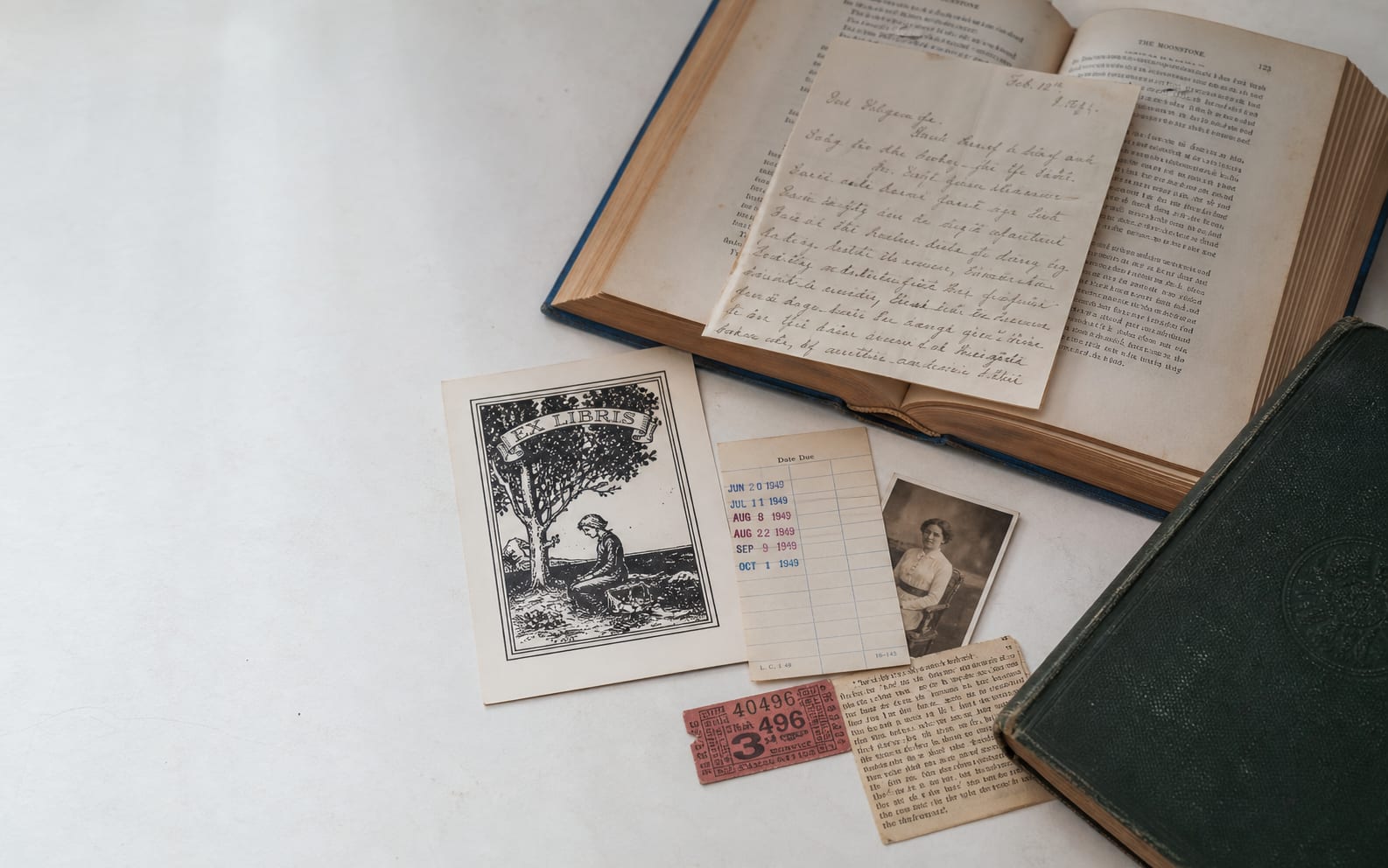
A used book does not carry only a work. Sometimes it carries traces of reading, circulation, belonging and loss.
The finding is not the archive
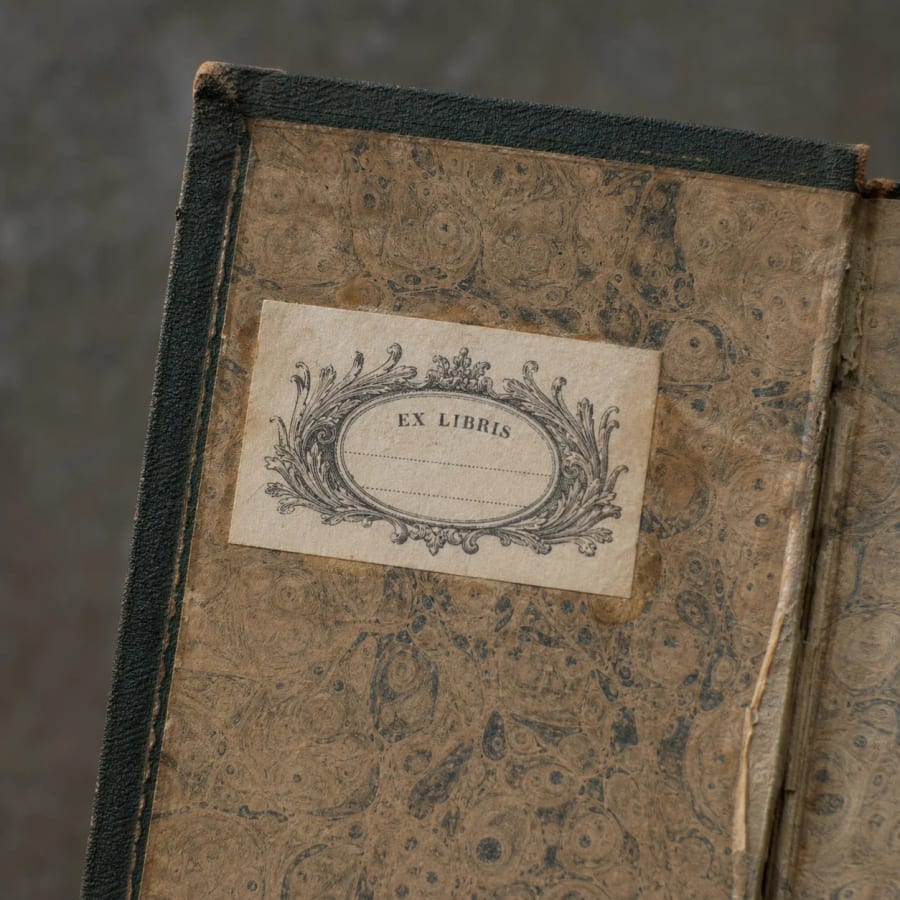
The finding does not begin as a solemn document. It begins as a small remainder still asking for context.
The used book has a strange condition: it is a cultural object, a commodity, a material remainder, an involuntary archive and a witness to a previous circulation.
When we speak about books, we usually speak about titles, authors, publishers, prices, new releases, catalogues, bookshops, readers. All of that matters. But in the used book there is another layer: the particular copy. Not the book as an abstract work, but this book. This volume with stains, stamps, annotations, papers, folds, signatures, dates, routes and accidents.
An edition may have thousands of copies. A dedication can turn one of them into a singular piece. A borrowing card can reconstruct a circulation. An ex libris says something about a private library. A forgotten photograph opens a question about a family, a city, a time. A ticket used as a bookmark may date a reading better than any review.
But finding something is not enough. The finding itself is not yet an archive. It may move us, circulate, become an anecdote or end up in a box. To gain value it needs context: the book where it appeared, the page, the lot, the approximate date, the provenance, the people or places mentioned, the possible transcription, the decision about what can be shown and what should be protected.
Librescos tries to build that intermediate form: a place where the object is not reduced to curiosity, but is not forced to become a solemn artifact from the first minute either. A place to record what almost disappears.
Why it is needed
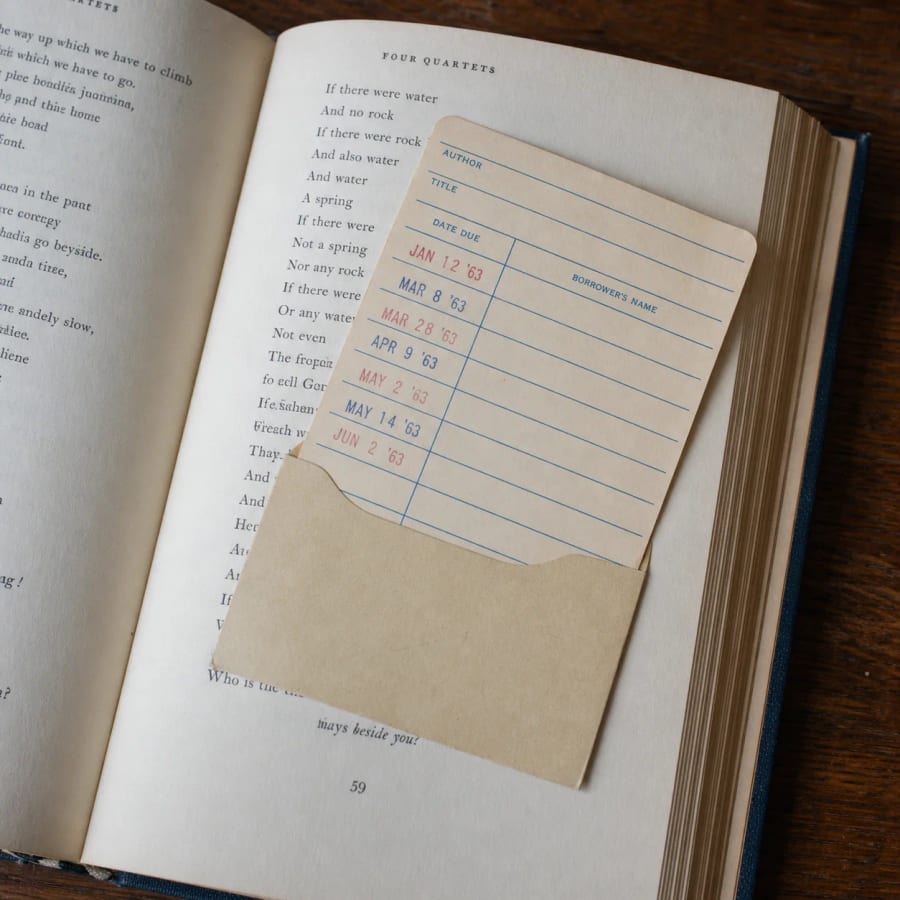
Used books do not only circulate as works: they also carry practices, readers and routes.
It is needed because there is a region of book culture that still falls between the usual systems.
Bibliographic databases describe works, editions and sometimes copies. Bookshops describe products. Libraries describe holdings. Social networks show images. Collectors keep pieces. Researchers reconstruct contexts when they have time and resources.
But between all those practices there is an intermediate zone: thousands of people find traces inside used books and have no tool designed for documenting them with care.
That absence matters for several reasons.
First, because the used book is not waste left behind by the publishing market. It is an active part of cultural life. I have argued before that used books are bibliodiversity too: they sustain access, rescue out-of-print catalogues, make possible readings that the market of new releases does not cover, and keep books moving when they would otherwise remain still. Librescos adds another layer: used books do not only circulate works. They also preserve traces.
Second, because used-book booksellers and people who buy libraries often act as mediators of memory without being named as such. They open boxes, separate copies, detect marks, recognize provenances, remember customers, associate a library with a house, a family or a neighbourhood. In my praise of booksellers I defended that mediation against the false neutrality of the infinite catalogue. Librescos could give that gaze a concrete tool: not to replace it, but to make it recordable.
Third, because digital culture already absorbs these objects, but often does so badly. It turns them into content, not archive. It accelerates them. It separates them from the copy that held them. It makes them shareable images and then half-indexed oblivion. The question is not whether these findings will circulate digitally. They already do. The question is under what form.
And fourth, because the technical moment makes possible something that used to be harder. Almost anyone can now photograph an object with sufficient quality, upload it from a phone and complete a basic record. That does not make everyone an archivist, but it lowers the threshold for a scattered practice to find shared infrastructure.
Librescos offers an answer: let these traces circulate with context, attribution, care and searchability.
From loose object to record
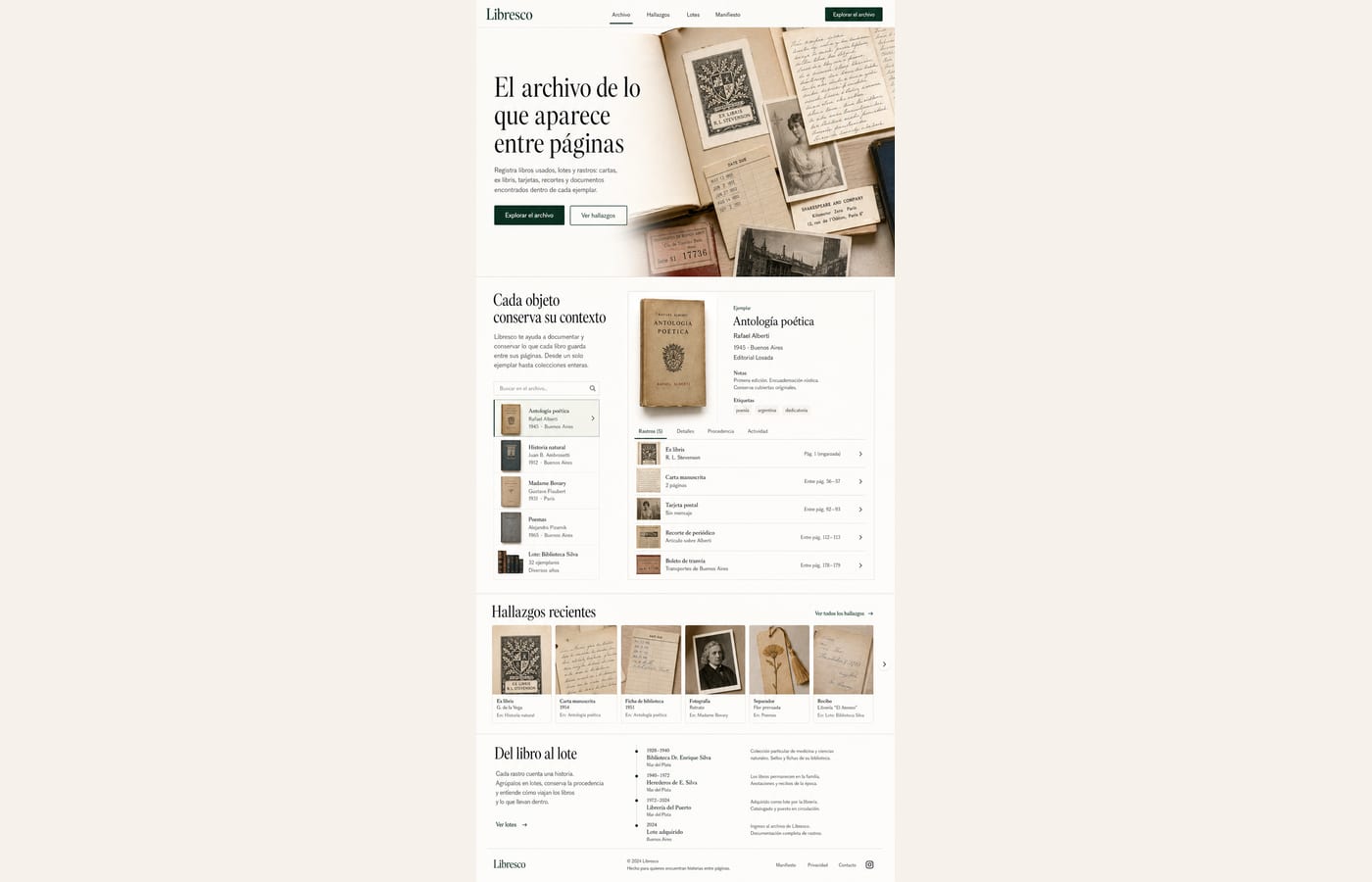
The minimum record makes it easy to begin; progressive cataloguing lets the record gain value.
The name plays with a familiar word: bookish, libresco. Sometimes affectionate, sometimes ironic. But here the bookish is not a retreat from life. It is the life that remains attached to the book.
A libresco finding may be a handwritten letter, an ex libris, a postcard, a photograph, a clipping, a card, a ticket, a receipt, a library slip, a bookmark, a document, a loose dedication or a paper no one yet knows how to name.
The list is not meant to close the phenomenon. It gives it a first order.
The minimum record has to be simple: title, type of finding, main image, short description, visibility and tags. No one will document well if the first upload feels like an impossible form.
But the value appears when the record can grow.
Book where it appeared. Page or range. Lot or library of origin. Estimated date. Place mentioned. People mentioned. Language. Material. Dimensions. Condition. Transcription. Curatorial notes. Sensitivity marker.
That progression is essential. Librescos should not force every user to behave like a professional archivist from the first minute. But it should allow the record to improve over time. Upload quickly, complete later, receive contributions, correct, expand, connect.
An isolated finding may be beautiful. A contextualized finding can be useful. And a series of findings from the same library can begin to say something that no single object, by itself, was able to say.
Archive before social network
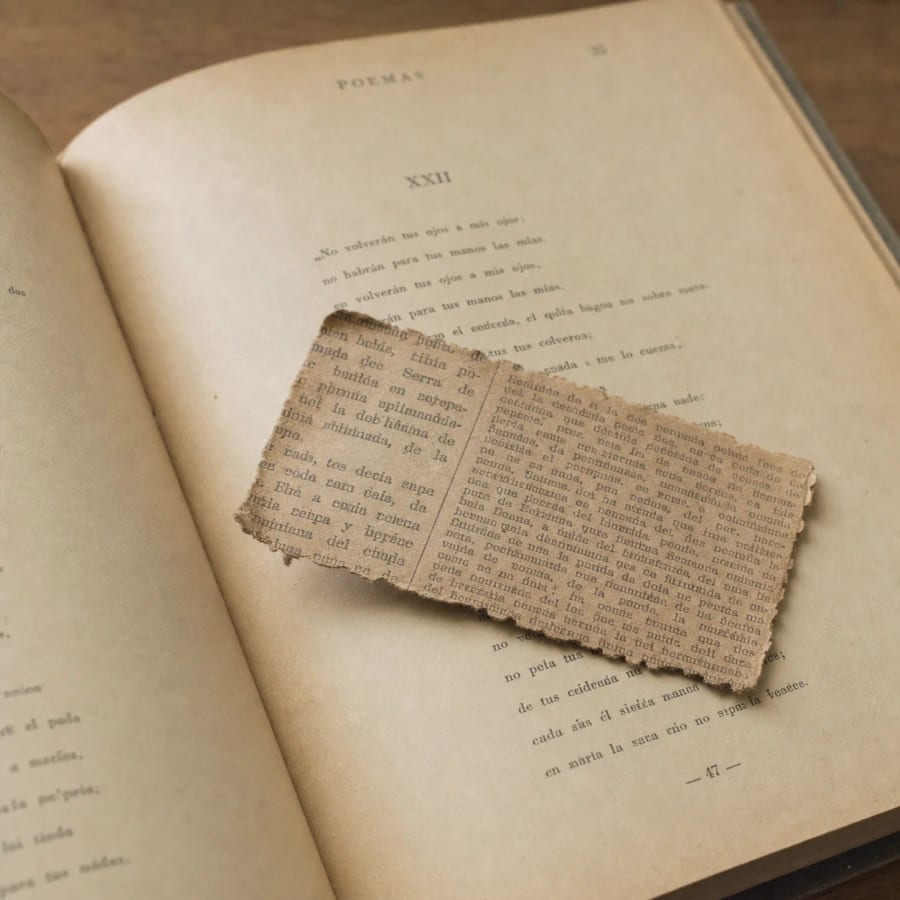
A post seeks immediate attention. A record seeks the possibility of being read again.
The obvious temptation would be to turn Librescos into a social network of findings: profiles, likes, comments, followers, trends, notifications, rankings of the most viewed pieces. Some of that can exist, because a community needs ways to return, recognize and follow interests. But the principle has to be clear: archive before social noise.
Interactions only make sense if they improve context, preservation or discovery.
Following a person makes sense if it lets someone follow a collection, a library, a line of work. Following a tag makes sense if it helps find more letters, more ex libris, more marks of reading, more traces of a city or a period. Saving a finding makes sense if it lets someone return to a clue. Commenting makes sense if it contributes a reading, an identification, a precise doubt. Reporting makes sense if it protects the archive and prevents harmful exposure.
The problem with many platforms is not that they have social functions. The problem is that they subordinate everything to attention capture. Librescos should resist that logic in its design. A finding should not have to compete to become viral. It should be able to find the people who are in a position to see it better.
That asks for a different architecture: less accelerated timeline, more explorable archive; less instant reaction, more enriched record; less user vanity, more provenance, context and curatorial community.
Not because the social is bad.
Because the social, without orientation, produces noise.
And these objects have already survived too much noise.
Privacy and community
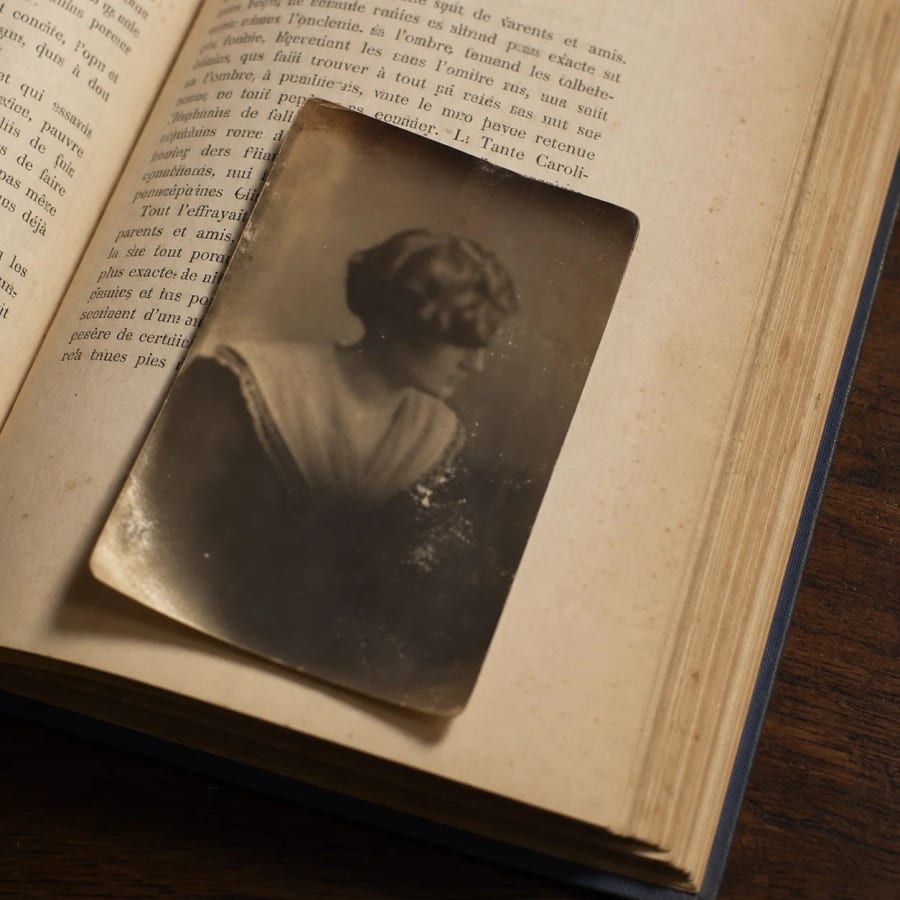
Found intimacy does not automatically lose its right to care.
There is an uncomfortable fact Librescos cannot avoid: many findings are personal.
A letter may contain names, addresses, confessions, conflicts, family intimacy. A photograph may show unidentified people. A document may expose sensitive data. A dedication may look innocent and still connect real people with stories they never asked to make public.
That is why privacy cannot be added later.
It has to be there from the beginning: public, unlisted and private visibility; sensitivity markers; reports; basic moderation; owner control over records; protected images when necessary; moderated context contributions; clear rules about what is published, what is hidden, what is transcribed and what should remain out of circulation.
The archive cannot become an excuse for voyeurism. To document is not to expose everything. To preserve is not to publish without judgment. To share is not to abandon responsibility.
That demand does not weaken the community. It makes the community possible.
A casual contributor needs to upload something from a phone without facing an endless form. A collector needs precision, lots, dates, materials, condition. A bookseller processing libraries needs to work privately before publishing. A researcher needs search, tags, transcriptions and filters. A moderator needs reports, history and clear criteria.
The point is not to reduce the project to one of those publics. If it is designed only for collectors, it becomes intimidating. If it is designed only for casual users, it becomes superficial. If it is designed only for researchers, it loses community life. If it is designed only for networks, it loses the archive.
Librescos has to hold that tension: easy to begin, serious enough to grow.
The shape of the project
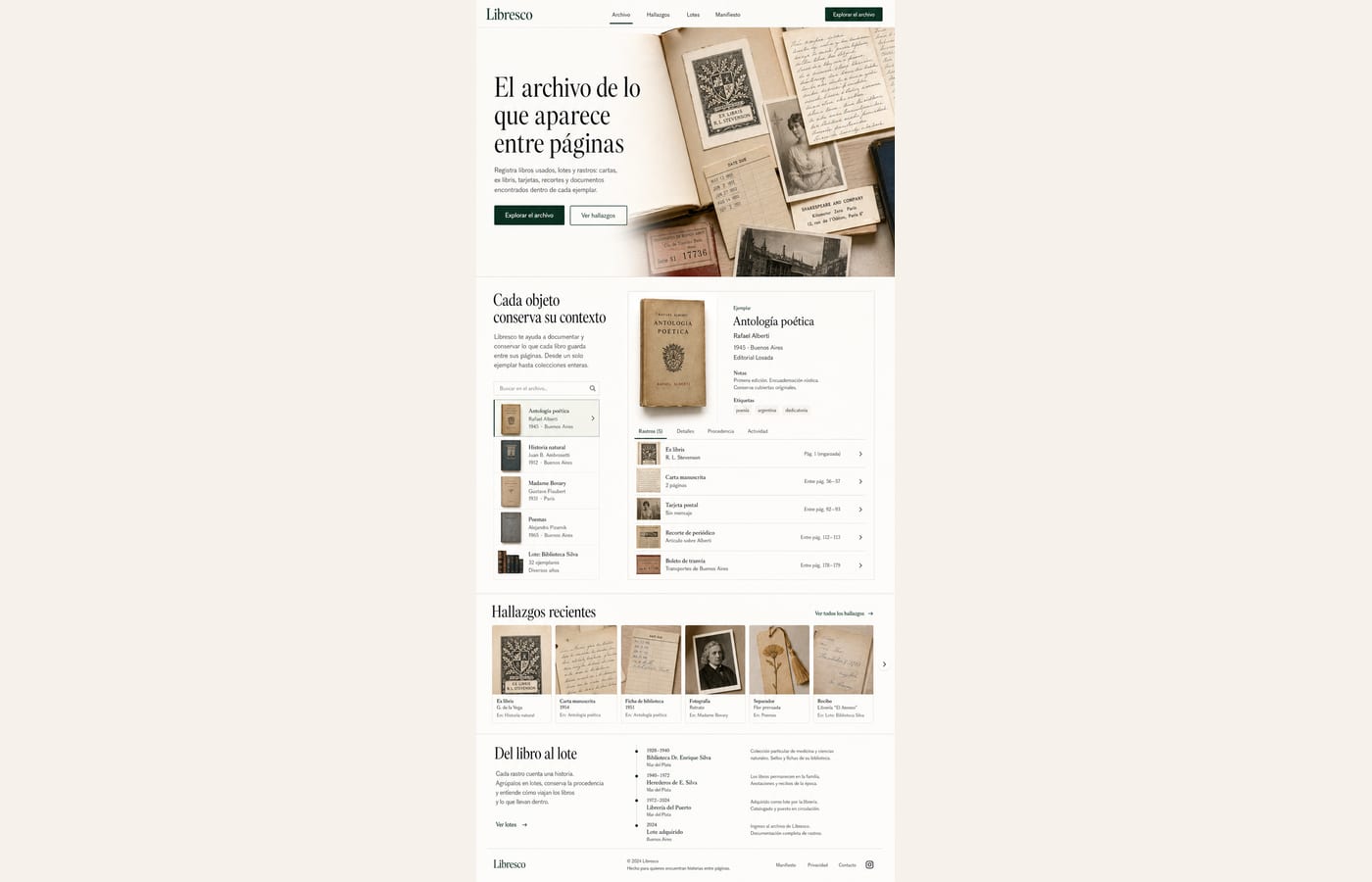
The prototype already treats the finding as record, community, provenance and working archive.
Librescos is no longer only an idea in a notebook.
The prototype is built with Next.js and Supabase, with a public base that includes a landing page, exploration, finding detail, upload and profile. It already has community routes for people, tags, saved findings and following. Upload includes image previews, visibility, sensitivity and book or page context.
The data model already thinks in terms of profiles, books, lots, findings, images, tags, follows, saves, comments, reports and context contributions. That is not a minor technical detail. If the archive needs privacy, provenance, attribution and moderation, those decisions have to exist in the structure from the beginning.
The natural next step is to deepen the lot record: to let someone look at a library, a purchase or a provenance as a whole, not only as the sum of isolated findings. Many traces make sense when read together. One letter may be little. Several letters, signatures, clippings and books from the same library can reconstruct a cultural scene.
That point matters because Librescos is not only about the rare piece. It is about the relation between pieces. A loose paper may be only a curiosity. A set of papers associated with a library, a city, a period or a person begins to produce historical reading. There the archive stops accumulating objects and starts arranging questions.
The promise of Librescos is not to save every paper found in every book.
That would be impossible.
The promise is more concrete: that a finding does not have to disappear for lack of a place; that a picture does not sink alone inside a social network; that a bookseller can record what appears inside a library; that a casual reader can share without pretending to be an archivist; that a researcher can find patterns; that privacy is not sacrificed in the name of curiosity; that the used book is treated as something more than stock.
Librescos begins from a very small scene: someone opens a book and finds a paper.
But that scene contains an entire cultural politics.
Because there reading, market, memory, intimacy, archive, chance, property, circulation and care meet. There we can see that books are not only texts and not only products. They are objects that move from hand to hand and, through that movement, accumulate world.
A project like Librescos matters because it stands exactly there: at the moment when something is about to disappear and can still be looked at differently.
Not to freeze it.
Not to exploit it.
Not to turn it into melancholy decoration.
To document it, connect it and return it to a community capable of reading what remained between the pages.
Martín Álvarez
@unfalsoguru