AI did not kill the author
The scandal around Olga Tokarczuk was useful because it exposed a lazy reflex.
Not a literary reflex.
A police reflex.
The story moved quickly: a Nobel Prize winner had used AI, or seemed to have used AI, or someone said she had used AI, or an article framed it that way, and suddenly the serious question was no longer how a novel is made, what long fiction costs, what research means, what authorship promises or what responsibility remains when tools enter the work. The question became simpler and poorer:
was there AI?

The long novel demands permanence. The prompt promises response. The tension begins when both sit on the same table.
That question can be legitimate.
It becomes stupid when it replaces reading.
It was not a confession, it was a symptom
The Tokarczuk episode was not interesting because it proved that AI had written literature.
It did not.
It was interesting because it showed how fast the public conversation turns a tool into a verdict. A novelist speaks about using AI in relation to documentation, characters or research, the mediation gets flattened, headlines harden the suspicion, and the discussion becomes a trial of purity.
That is a symptom.
It reveals how little patience we have for the actual labor of writing.
Writing a novel is not only producing sentences. It is organizing time, attention, documents, voices, memory, rhythm, architecture, money, fatigue and risk. It is deciding what kind of world a book can hold without collapsing. A tool can assist parts of that labor. It can also damage them. But it does not explain the work by itself.
The scandal wanted a clean crime scene.
Literature rarely offers one.
That does not mean anything goes. The opposite is true. Because literature is made through mediated processes, one has to look more carefully at the mediation. Who chose it? What did it replace? What did it make visible? What did it hide? What did it make easier to fake? The clean crime scene is a fantasy; the messy work table is where responsibility can actually be found.
The long novel is an expensive animal
Tokarczuk’s remark about the economic difficulty of writing long novels mattered more than the AI panic around it.
The long novel is expensive in the broadest sense. It demands time that often cannot be paid. It demands research, notes, false starts, structural failure, years of attention, and a kind of endurance that the market usually does not reward unless success has already arrived.
A short text can be written between obligations.
A long novel reorganizes life.
That is why the controversy was so revealing. Instead of discussing the material conditions that make long literary work harder, many preferred to discuss whether a machine had contaminated the process. The moral panic hid the economic question.
If writers use tools to manage documentation, compare versions, organize archives, translate fragments, summarize research or test continuity, perhaps the first question should not be “is the author dead?” It should be: why has the literary economy become so hostile to the time required by literature?
AI did not invent that problem.
It entered it.
The long novel is also a bad fit for the attention economy around controversy. A scandal wants an immediate position. A novel asks for duration. A scandal asks who is guilty. A novel asks what kind of world can be sustained. The speed of the AI debate therefore clashes with the slowness of the form being discussed.
That clash is part of the story.
The bad question returns
The bad question is: did the author use AI?
The better question is: what did the author delegate?
There is an enormous difference between using a tool to search an archive and letting the tool decide the scene. Between asking for variants and accepting a voice one cannot defend. Between checking continuity and outsourcing imagination. Between using a model as a notebook and using it as an alibi.
The tool can sit on the table.
The author still has to sign.
That distinction is less spectacular than accusation, but much more useful.
It allows us to criticize actual procedures instead of hunting for traces. It allows us to say that some uses are harmless, some are productive, some are mediocre, some are dishonest and some are aesthetically disastrous.
It also allows us to ask for disclosure when the use of AI changes the promise made to the reader.
Not every tool requires confession.
But every authorial position requires responsibility.
A useful disclosure policy would begin there. It would not demand theatrical purity or force writers to list every instrument they touched. It would ask whether the tool changed the nature of the work being offered. Did it generate passages presented as the author’s prose? Did it produce research that was not independently checked? Did it shape characters, structure or scenes in a way the author cannot defend? Did a publisher use AI in editing, translation or marketing in a way that affects the reader’s trust?
Those are better questions than a yes-or-no badge.
The author function did not die
Barthes did not kill the person who writes.
Foucault did not erase responsibility from the page.
Both made the figure of the author more complex. The author is not simply a sacred origin from which meaning flows. The text is made of citations, languages, institutions, genres, expectations, markets and readers. The author is also a function: a way of classifying, attributing, limiting, authorizing and organizing discourse.
AI does not eliminate that function.
It pressures it.
If a model participates in the process, the question becomes sharper: who assumes the position from which the work is offered? Who answers for the form? Who chose, cut, arranged, rejected, verified, signed?
The author is not the only origin of the text.
But the author remains the one who must answer for the text’s public form.
That answer cannot be delegated to theory. It is not enough to say that the author was already dead, or that all writing is intertextual, or that every text is a collage. Those claims may complicate origin, but they do not erase the practical situation in which a name appears on a cover and a reader is invited to trust it.
The cover is not metaphysics.
It is a promise.
From archive to destiny
One of the most important distinctions is the difference between archive and destiny.
A writer can use technologies to gather material. Notes, search engines, databases, transcription tools, digital libraries, maps, timelines, concordances, image archives. Literature has always used external memory. A novel can be full of documents without becoming a document.
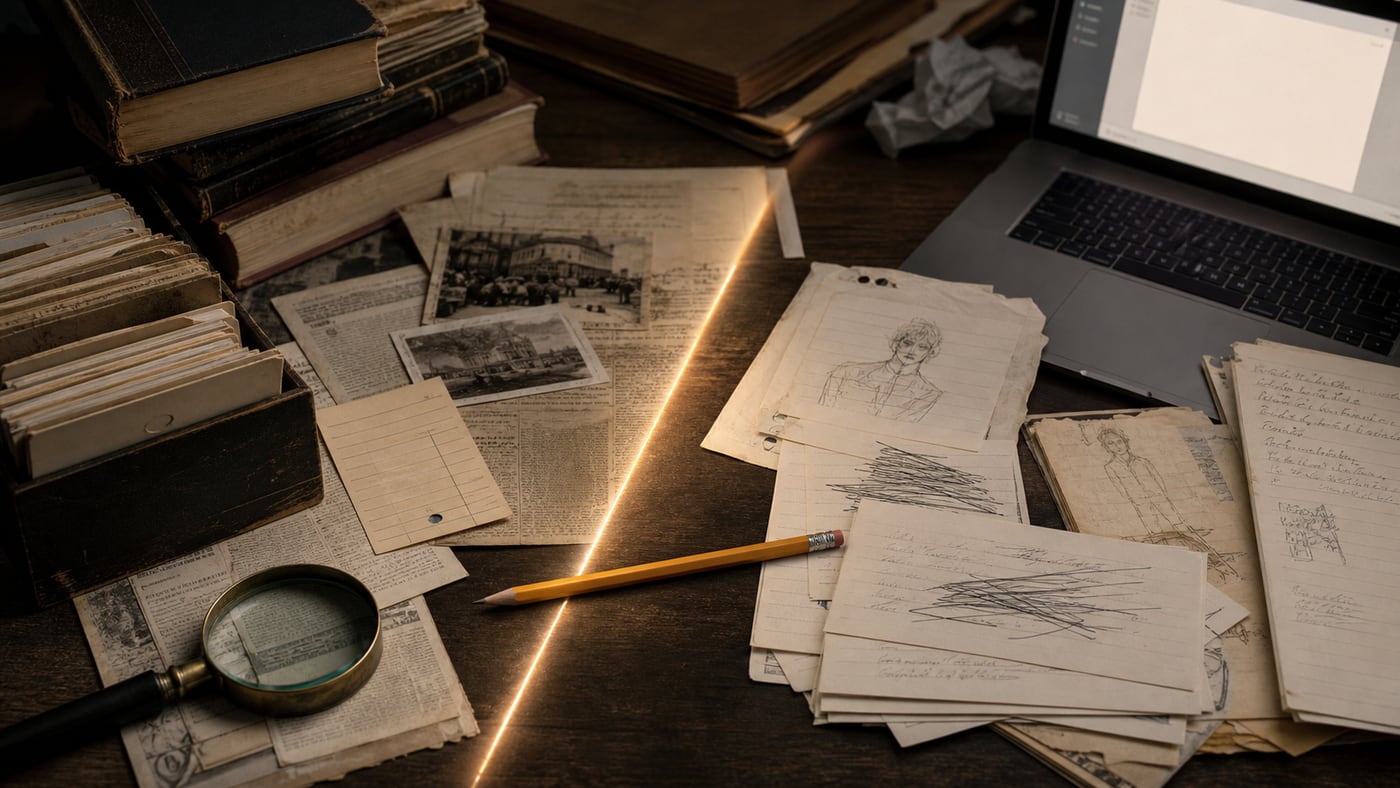
The line does not separate technology and literature. It separates two uses: looking for material and letting the material decide the scene.
The problem begins when the archive becomes destiny.
When the available material dictates what can be imagined.
When a model’s fluency makes a scene feel finished before the author has made a decision.
When documentation stops feeding fiction and begins replacing the pressure of form.
That danger is real.
But it is not unique to AI. Academic research can also suffocate a novel. Historical fidelity can become cowardice. A pile of notes can hide the absence of vision. The machine is one more way for writing to avoid its own risk.
It can also be one more way to organize that risk. A writer may use a model to test a chronology and then reject its simplifications. To generate names and discard them. To summarize documents and return to the documents. To produce a wrong version that reveals what the right version must not do.
The ethical line does not run between human and machine.
It runs between assistance and abdication.
A machine has no psychotope
Tokarczuk has used the word psychotope to describe a psychic place, a charged territory of narrative attention. Whether one uses that term or not, the point is useful: a novel is not only information arranged in order. It is a world of pressure, atmosphere, memory, desire and relation.
A model can imitate descriptions of that world.
It can produce a plausible paragraph.
It can keep names consistent for a while.
It can propose a scene that looks like fiction.
But it does not inhabit a psychotope.
It does not carry the weight of the world it describes.
It does not know why a detail should wound.
It does not know when a character has become too convenient.
It does not know when a beautiful sentence has betrayed the book.
That remains the author’s work.
And it is work in the strongest sense: not inspiration floating above the desk, but repeated decisions under pressure. The paragraph that sounds good but does not belong. The character who has become a function. The historical detail that seduces but breaks the book. The sentence that must remain strange because the world of the novel requires that strangeness.
No detector can do that work.
No model can assume it.
The detector does not read either
The opposite error is to replace reading with detection.
A detector can warn. It can produce a probability. It can identify patterns. It can be useful in limited contexts. But it does not read.
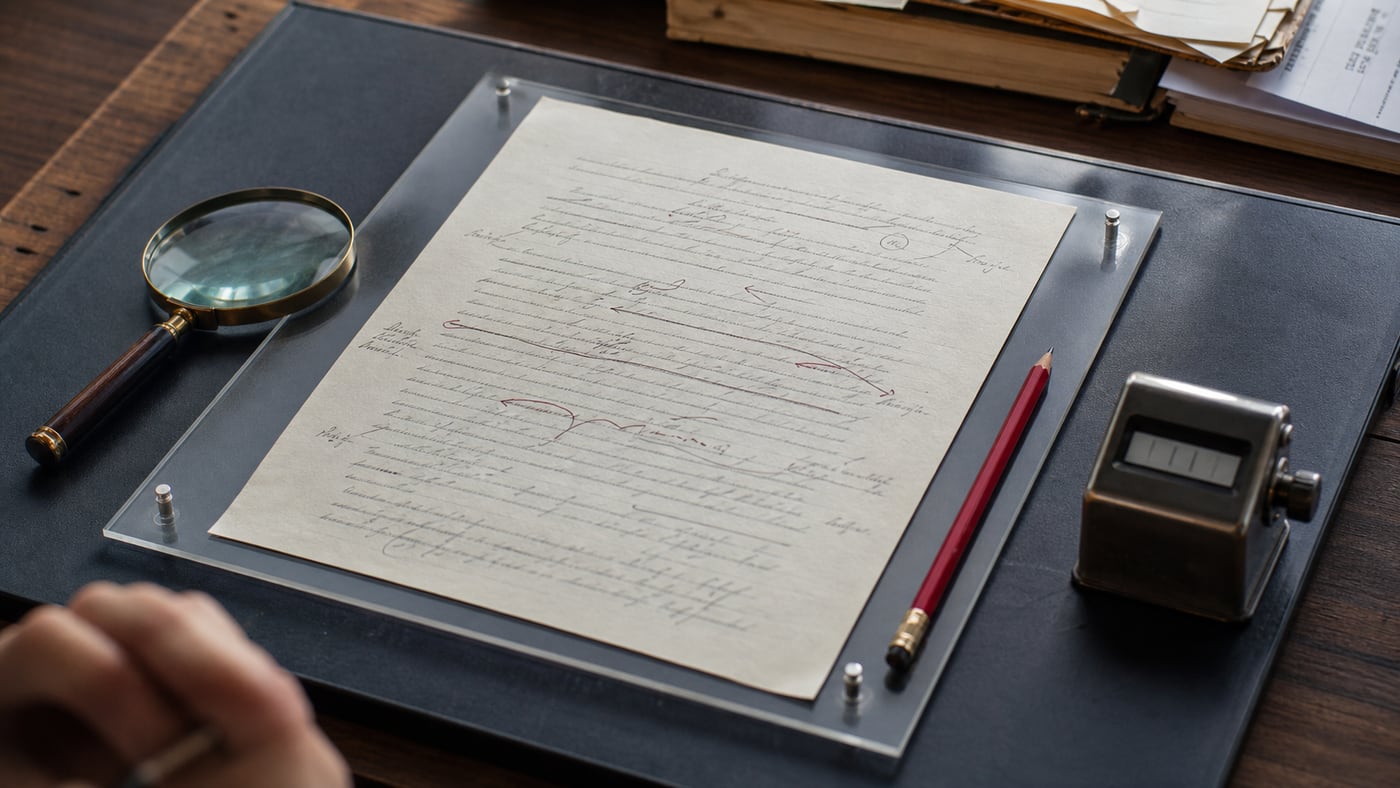
The detector can warn. Reading has to do the work the detector cannot.
A detector cannot tell whether a sentence is necessary.
It cannot tell whether a voice is alive.
It cannot understand irony, research, influence, translation, editorial intervention, habit or style.
It can accuse the wrong person and absolve a dead text.
That is why literary criticism cannot become border control. It has to return to the page. If a book is weak, say how. If it lies, show where. If it delegates too much, explain what has been lost. If it uses a tool without losing its form, do not pretend suspicion is enough.
This matters beyond Tokarczuk. We are entering a period in which every polished text can be suspected and every clumsy text can be romanticized as human. That is a terrible standard for literature. It rewards surface signs instead of reading. It asks prose to perform innocence.
Literature deserves better than forensic laziness.
Purity can also become a market
The new market will sell purity.
Human-authored certificates.
Clean labels.
Promises of untouched language.
Some of that may be useful in specific contexts, especially where contracts, rights or institutional rules require clarity. But purity can also become branding. It can turn the absence of a tool into a moral commodity while leaving untouched the old problems: ghostwriting, formula, market pressure, editorial overproduction, prestige laundering and industrial language written by humans.
The issue is not purity.
The issue is responsibility.
A bad human text is not saved by being human.
A good text is not destroyed by the mere presence of a tool.
The market will prefer simpler labels because labels are easy to sell. “Human-authored” can become another prestige stamp, useful sometimes, empty other times. It may reassure readers while doing nothing to improve reading. It may also punish honest disclosure and reward silent use.
If the label replaces criticism, it will have solved very little.
Work table, not oracle
The machine should be on the work table, not on the altar.
It can help search.
It can suggest.
It can contradict.
It can organize.
It can accelerate boring operations.
It can also flatten, lie, imitate, seduce and make laziness look like method.
That is why the decisive question is not whether AI killed the author.
It did not.
The decisive question is whether the author is still willing to do the work of authorship: choosing, cutting, checking, sustaining a voice, assuming a form and answering for the result.
That work may include tools, but it cannot be replaced by them. A writer who uses AI still has to know when the machine has produced a convenient lie, a dead metaphor, a generic rhythm, a false source, a scene that functions but does not belong. Without that judgment, the tool does not extend authorship. It empties it.
AI did not kill the author.
But it did make the author’s responsibilities harder to fake.
That may be the uncomfortable gift of the controversy. It forces us to stop treating authorship as either sacred solitude or dead theory. Authorship is a practice of responsibility inside a chain of tools, readings, institutions and decisions.
The machine can enter that chain.
It cannot answer for it.
Only the author, editor and publisher can do that. The reader should ask them for that answer, not ask the detector to replace the reading.
That demand is harder than scandal, but it is the only one literature can take seriously.
The rest is noise around the desk.
And the desk is where literature still has to happen.
Someone still has to answer for what happens there.
Martín Álvarez
@unfalsoguru